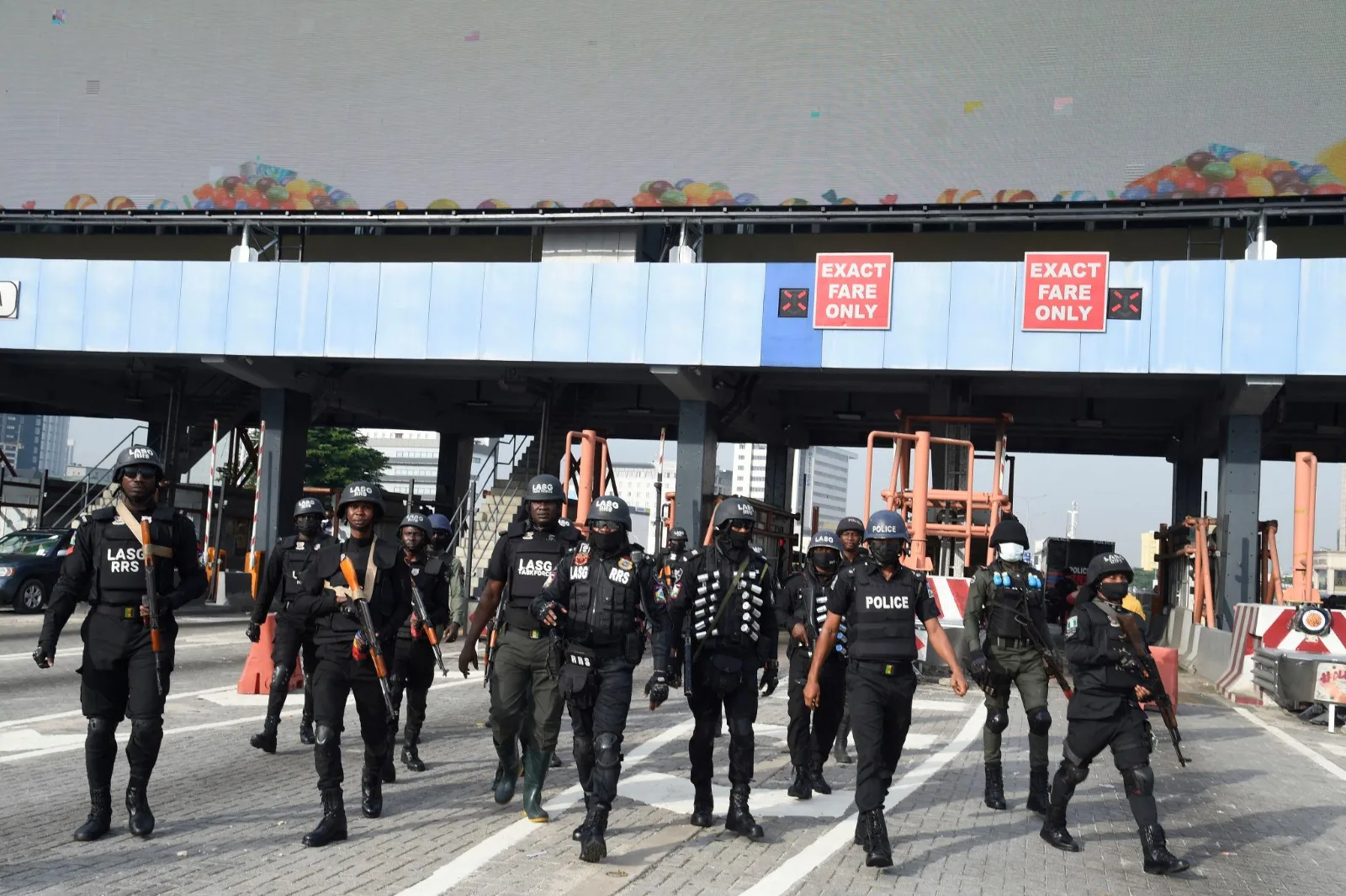
Police fired tear gas at residents, journalists, activists and political figures who gathered for a wreath-laying ceremony organised by EiE (Enough is Enough Nigeria). The event, scheduled for 11 a.m., was intended to honour people who died or went missing during the October 2020 demonstrations against police brutality.
According to TheCable's report, officers dispersed participants before the planned ceremony could begin. Among those present were Gbadebo Rhodes-Vivour of the African Democratic Congress and Funso Doherty of the Nigeria Democratic Congress, both Lagos governorship candidates.
The organisers had prepared 15 wreaths, including nine for people listed as dead in connection with the Lekki incident, four for those listed as missing and presumed dead, one for journalist Pelumi Onifade and another for unidentified victims.
The gathering ended without the wreaths being laid. As of early Tuesday afternoon, the Lagos State Police Command had not provided a publicly reported explanation for the dispersal.
Why October 20 remains important
The memorial marks six years since one of the most disputed events in Nigeria's recent history.
In October 2020, thousands of young Nigerians protested against police brutality, extortion and unlawful arrests, particularly abuses associated with SARS (Special Anti-Robbery Squad), a unit of the Nigeria Police Force.
Although the government disbanded SARS on October 11, demonstrations continued as protesters demanded accountability and wider changes to policing.
On October 20, security forces intervened at the Lekki Toll Gate, where protesters had gathered.
A judicial panel established by the Lagos State Government subsequently concluded that unarmed protesters had been shot and killed. However, the government disputed important aspects of the panel's findings, including its conclusions about the number of deaths.
The state government's 2021 White Paper accepted 11 of the panel's 32 recommendations, accepted six with modifications, rejected one and referred 14 to the Federal Government.
Questions about accountability, compensation and the implementation of those recommendations have remained central to subsequent anniversaries.
A court had already ruled against police actions at an earlier memorial
Tuesday's incident is not the first confrontation between police officers and people commemorating #EndSARS.
On October 20, 2024, officers dispersed another anniversary gathering at the Lekki Toll Gate and arrested several participants.
In July 2025, a Federal High Court in Lagos ruled that the arrests and harassment violated the demonstrators' constitutional rights.
Justice Musa Kakaki ordered the Inspector-General of Police and the Lagos State Commissioner of Police to pay ₦10 million in damages to the affected protesters.
The court ruling, reported by TheCable, reinforced protections under Section 40 of Nigeria's Constitution, which guarantees freedom of peaceful assembly and association.
That judgment concerned the 2024 incident, not Tuesday's gathering. Nevertheless, it provides important legal context for examining how police authorities handle peaceful commemorations.
Rights groups renew demands for accountability
The sixth anniversary has also brought renewed criticism of Nigeria's progress on police reform.
In an October 20 statement, Corporate Accountability and Public Participation Africa (CAPPA) called on federal and Lagos State authorities to apologise to victims, compensate affected families and prosecute personnel found responsible for abuses.
The organisation also urged political parties to make police accountability and victims' rights important commitments ahead of the 2027 elections.
Separately, the Rule of Law and Accountability Advocacy Centre argued that dissolving SARS had not sufficiently addressed longstanding complaints about police conduct.
Its concerns highlight a distinction between announcing reforms and ensuring that they change how officers interact with citizens.
What this means for Nigerians
Nigeria's Constitution protects peaceful assembly, although that right is subject to lawful restrictions. Police have a responsibility to maintain public safety, but their actions must remain within the law.
Tuesday's incident therefore raises an important question: Why was a memorial gathering dispersed with tear gas when participants had assembled to remember victims of alleged state abuses?
An official police explanation, accountability for any unlawful conduct and transparent implementation of previous reform recommendations would help answer the question.
Six years after #EndSARS, the debate is no longer simply about whether SARS was disbanded. It is about whether Nigerians can see meaningful improvements in policing, accountability and the protection of their constitutional rights.