Long before Nigeria had a name, borders, kingdoms or written records, people were already living in the land. Archaeological discoveries in present-day Nigeria take that human story back more than 10,000 years—and one rock shelter in Ondo State provides some of the clearest evidence.
Nigeria officially came into existence as a single colonial territory in 1914, when Britain amalgamated its Northern and Southern protectorates. But the history of people living within Nigeria's present borders is vastly older.
To find its earliest chapters, we have to go underground.
There are no newspapers, government records or written chronicles from this period. Instead, archaeologists reconstruct the story from stone tools, charcoal, animal remains, plant material, pottery, human remains and layers of soil left behind by people who lived thousands of years ago.
One of the most important places in that story is Ihò Eléérú, also commonly written as Iwo Eleru, a rock shelter near Akure in present-day Ondo State.
Researchers now have evidence of human activity there going back roughly 13,000 years.
A shelter containing thousands of years of history
Ihò Eléérú sits among rocky hills about 25 kilometres northwest of Akure.
The site was documented by Nigeria's Department of Antiquities in the early 1960s and excavated by archaeologist Thurstan Shaw and S.G.H. Daniels between 1963 and 1964. Archaeologists found approximately 1.8 metres of accumulated deposits containing large amounts of material left by people who occupied the area at different times.
Those layers are important because archaeological sites can work somewhat like a historical stack.
Material deposited deeper underground is generally older than material above it, provided the layers have not subsequently been disturbed. Researchers can study those layers and date material found within them to reconstruct how people used a place over long periods.
At Ihò Eléérú, the evidence stretches from the end of the Pleistocene, roughly 13,000 years ago, through later periods of human occupation. Modern research describes the site as containing evidence of repeated human presence from the Later Stone Age into much more recent times.
That puts people in what is now southwestern Nigeria thousands of years before the emergence of the famous kingdoms and states most Nigerians encounter when learning the country's early history.
Then archaeologists found a person
Ihò Eléérú became even more significant because archaeologists did not find only tools and traces of human activity.
They found human remains.
In 1965, Shaw and his team excavated a skeleton from an undisturbed Later Stone Age context in the rock shelter.
Charcoal found close to the burial initially produced a radiocarbon measurement of 11,200 ± 200 years before present. When calibrated, researchers placed the context at approximately 13,000 years ago.
Parts of the skull, jaw and other skeletal remains survived.
That discovery gave researchers something unusually valuable: physical human remains associated with one of West Africa's ancient populations.
Later research described Ihò Eléérú as the only site in western Africa from which Pleistocene-age hominin fossils have been recovered.
But the discovery also created questions that researchers are still trying to understand.
The skull did not look exactly as researchers expected
When the remains were originally studied, researchers noticed that some features of the skull differed from those typically observed among more recent African populations.
Decades later, scientists returned to the specimen with modern methods.
A 2011 study comparing the shape of the Ihò Eléérú skull with other human remains found an unusual combination of characteristics. The researchers concluded that its morphology was distinct from both recent modern humans and the Late Pleistocene humans included in their comparisons.
That does not mean archaeologists discovered a separate Nigerian species of human.
Nor does it establish that the person belonged to any present-day Nigerian ethnic group.
Instead, the remains contribute to a much larger scientific discussion about the complexity and diversity of ancient African human populations.
Africa's human history was not necessarily a simple story in which one uniform population spread across the continent. Different populations could have lived in different regions, interacted and changed over very long periods.
Ihò Eléérú provides one small but important piece of that much larger puzzle.
What was Nigeria like 13,000 years ago?
It certainly did not look politically or socially like Nigeria today.
There was no Nigeria.
There was no Lagos State or Ondo State. There were no colonial borders, and the later kingdoms and empires associated with Nigerian history had not yet appeared in the forms for which they became famous.
Even the environment was changing.
Research published in 2023 reconstructed approximately 14,000 years of environmental history around Ihò Eléérú. It found that the rock shelter remained within a relatively persistent area of forest even as the wider regional environment changed between forest and savanna conditions.
For the people using the shelter, the surrounding landscape provided resources that could support hunting, gathering and other activities.
Archaeologists classify much of the early material at the site as belonging to the Later Stone Age.
That description refers to an archaeological period characterised partly by particular forms of stone-tool technology. It should not be read as meaning the people were unintelligent or simply living an undeveloped version of modern life.
They possessed knowledge suited to the environment in which they lived: where resources could be found, which materials could be transformed into tools and how to survive within changing landscapes.
Their tools became part of the evidence they left behind.
Ihò Eléérú is important—but it is not the beginning of humanity in Nigeria
There is an important distinction.
Finding evidence from roughly 13,000 years ago does not mean humans first arrived in present-day Nigeria 13,000 years ago.
It means archaeologists currently have evidence showing people were there by that period.
Absence of an older archaeological discovery is not proof that nobody was there earlier.
Nigeria's climate makes the search especially difficult. Tropical conditions can destroy organic material that might survive much longer in dry environments, while erosion, development and other processes can disturb ancient sites.
New archaeological discoveries can therefore push known timelines backwards.
Historians Toyin Falola and Matthew Heaton describe archaeological evidence as showing human societies continuously present across regions of what became Nigeria for several thousand years. These early societies were generally organised around relatively small communities rather than the large centralised states that appeared later.
That distinction matters.
The first history of the land is not necessarily a history of kings.
It is a history of communities.
From small communities to farming societies
Over thousands of years, ways of life changed.
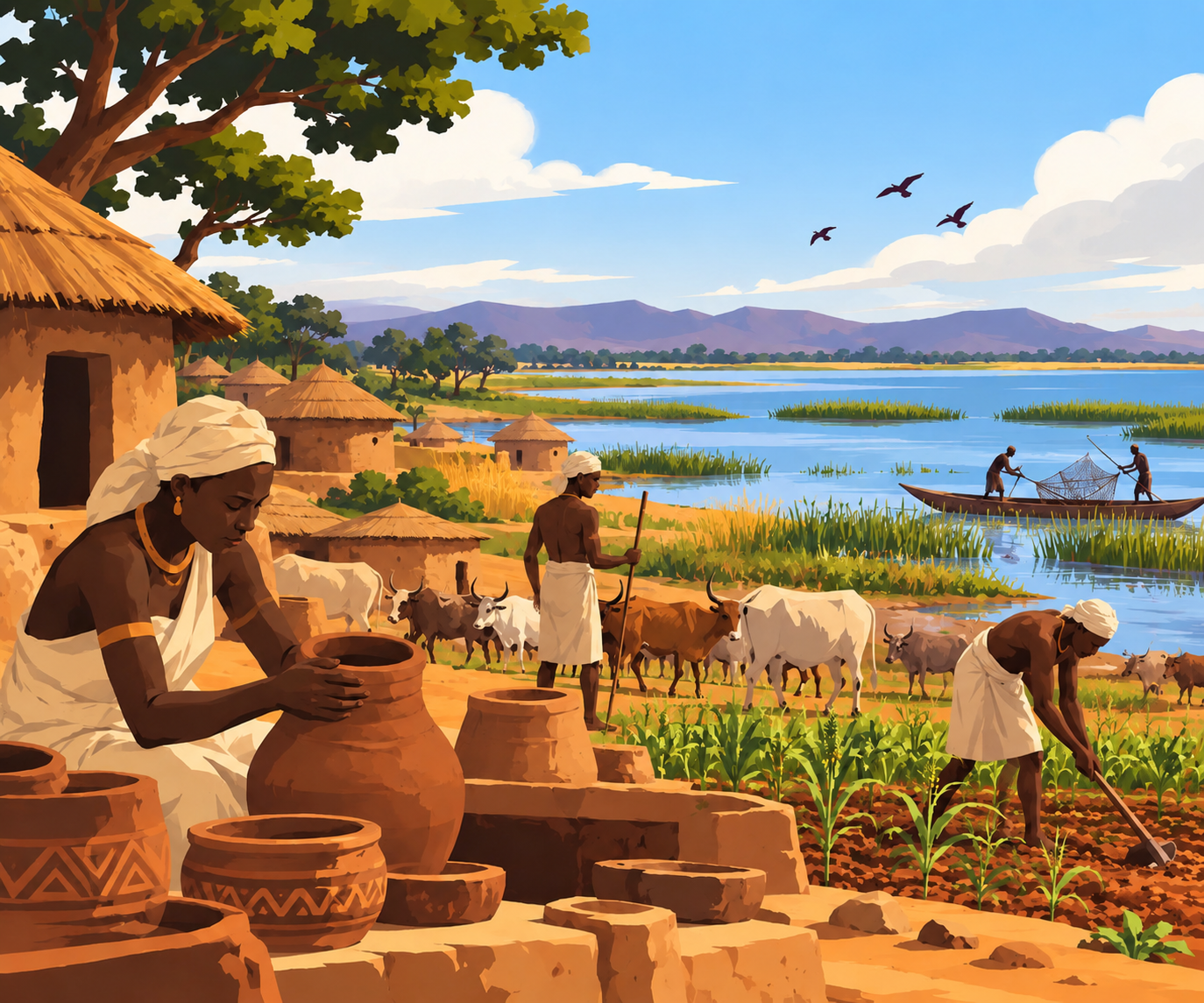
People experimented with different technologies and increasingly developed food-producing economies. Communities became more established, agriculture expanded and settlements changed in size and organisation.
The archaeological record is uneven, so this transformation did not occur everywhere at exactly the same time or in exactly the same way.
Different environments encouraged different ways of living.
The forests and forest margins of southern Nigeria, the Niger and Benue river systems, the Middle Belt, the Jos Plateau and the Lake Chad basin presented very different conditions.
Evidence from northeastern Nigeria, for example, provides another long sequence of settlement.
Archaeological research around Daima and the Lake Chad region established evidence of occupation extending from around the end of the second millennium BCE through the sixteenth or seventeenth century CE. Researchers studying the area have suggested that evidence of even earlier occupation may lie farther south in higher ground.
Nigeria's earliest history, therefore, cannot be reduced to one archaeological site or one migration.
It consists of many human stories unfolding across different environments.
Then came one of Nigeria's first great archaeological cultures
Thousands of years after the earliest evidence at Ihò Eléérú, communities in central Nigeria produced something that would become internationally famous.
The Nok culture emerged in the region around the Jos Plateau.
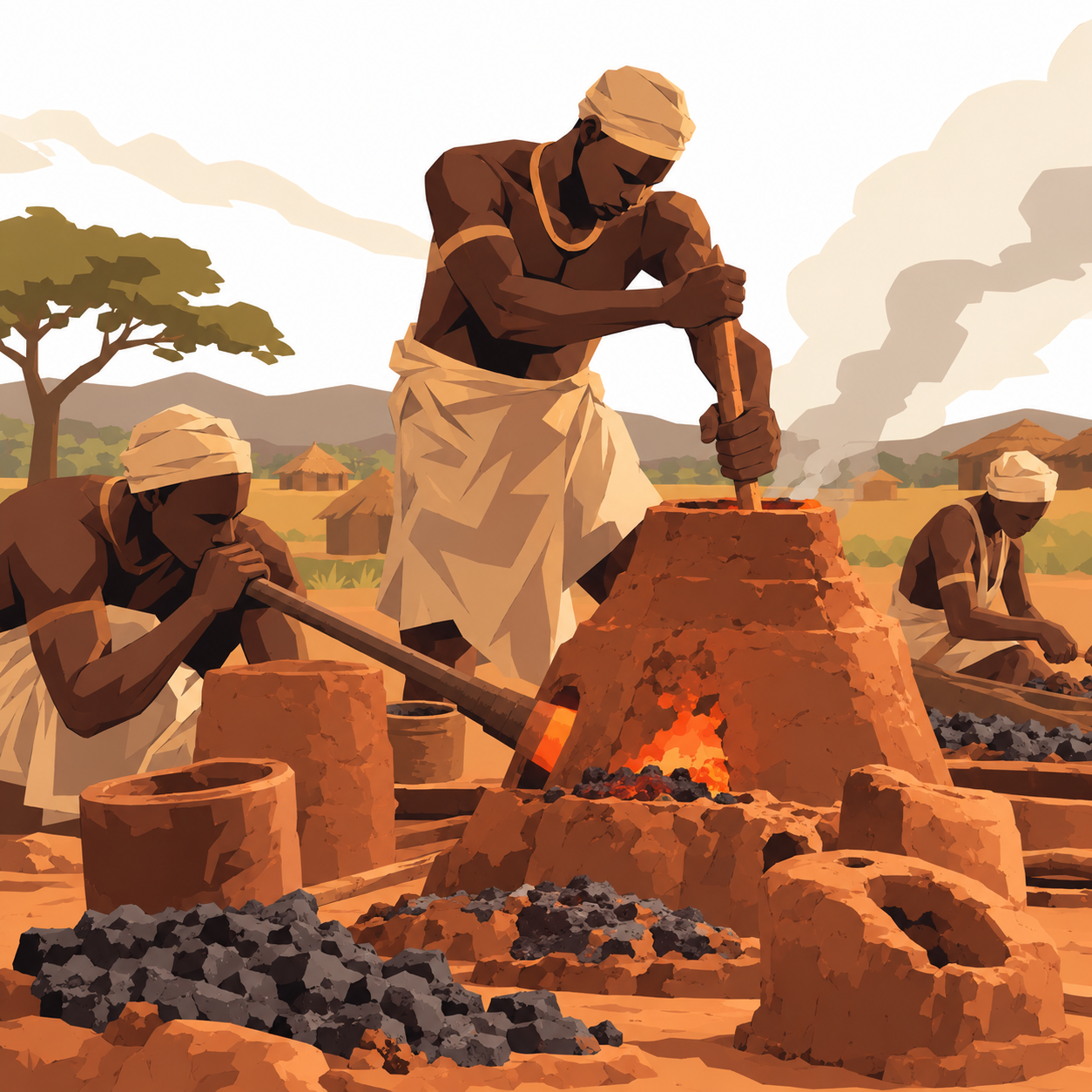
Current archaeological research places its beginnings around 1500 BCE, considerably earlier than scholars once thought. Nok communities farmed, produced elaborate terracotta sculptures and developed iron-smelting technology. Evidence indicates ironworking by roughly 900 BCE.
Nok is therefore enormously important to Nigerian history.
But Nok was not the beginning.
By the time Nok communities were producing their distinctive material culture, humans had already been living in parts of present-day Nigeria for many thousands of years.
And after Nok came other extraordinary developments.
Igbo-Ukwu would demonstrate sophisticated metalworking by around the ninth century CE. Ile-Ife would grow into a major urban and artistic centre. Benin would develop into a powerful kingdom. In the north and northeast, states and trading networks would connect communities across the Sahara and the wider Sahel.
Those are later chapters.
The first chapter is quieter.
We do not know what these people called themselves
This is perhaps the most important caution when talking about Nigeria's deepest history.
It is tempting to look at an ancient person found in present-day Ondo State and immediately attach a modern identity to them.
The evidence does not allow us to do that.
The fact that Ihò Eléérú is located in an area associated today with Yoruba communities does not establish that the people living there 13,000 years ago called themselves Yoruba or spoke a language recognisable as modern Yoruba.
Modern ethnic identities have their own long histories of formation, migration, interaction and political development.
Archaeology can show that people lived there.
It can sometimes tell us what they ate, the tools they made, the environment they encountered and aspects of how they treated their dead.
It cannot automatically tell us the name they used for themselves.
That boundary between what we know and what we want to know is important.
So, how old is human settlement in Nigeria?
There is no single date that can honestly answer that question.
What can be said is stronger than that.
Archaeological evidence establishes human occupation within the territory of present-day Nigeria going back at least roughly 13,000 years, while evidence from different sites shows communities continuing to occupy and transform the region across subsequent millennia.
Future discoveries could extend that known timeline.
And this changes the starting point of Nigerian history.
If Nigeria's story begins in 1914, then Britain appears almost at the beginning.
If it begins in 1960, independence becomes the beginning.
But neither is historically accurate.
1914 created the colonial political unit from which modern Nigeria emerged. It did not create the people, communities or histories inside it.
Long before the word Nigeria existed, people were already living, adapting and leaving traces of their lives across this land.
More than ten thousand years later, archaeologists are still uncovering their story.
What we know
Human beings occupied Ihò Eléérú in present-day Ondo State roughly 13,000 years ago. Archaeologists have recovered Later Stone Age material and human remains from the site, while other archaeological evidence demonstrates long histories of settlement in different parts of present-day Nigeria.
What we don't know
We cannot confidently identify the language, ethnicity or name used by the people who occupied Ihò Eléérú that long ago. Nor should the approximately 13,000-year date be treated as the date when humans first entered Nigeria; it represents surviving archaeological evidence currently available from an important site.
Why this matters
Nigeria is a relatively young state sitting on an extraordinarily old human landscape.
Understanding that difference makes the rest of Nigerian history easier to understand. The kingdoms, languages, identities, trade systems and political institutions that eventually developed here did not appear on empty land.
They emerged after thousands of years of human presence.
And that is where Openr's history of Nigeria begins.
Next: Nok: the ancient culture that was making terracotta art and working iron in Nigeria more than 2,000 years ago.
Sources
Toyin Falola and Matthew M. Heaton, A History of Nigeria, Cambridge University Press — overview of early human habitation and societies in the territory of modern Nigeria.
Aribidesi Usman and Toyin Falola, The Yoruba from Prehistory to the Present, Cambridge University Press — archaeological discussion of Later Stone Age occupation in the region.
Katerina Harvati and colleagues, The Later Stone Age Calvaria from Iwo Eleru, Nigeria: Morphology and Chronology, PLOS ONE — analysis and dating of the human remains recovered at Ihò Eléérú.
Patrick Roberts and colleagues, Human interactions with tropical environments over the last 14,000 years at Iho Eleru, Nigeria, iScience — modern reconstruction of the site's occupation and environmental history.
Graham Connah, The Daima Sequence and the Prehistoric Chronology of the Lake Chad Region of Nigeria, The Journal of African History — archaeological chronology for northeastern Nigeria.
The Metropolitan Museum of Art, Arts of Africa — archaeological context for Nok, early Nigerian ironworking and later technological and urban development.