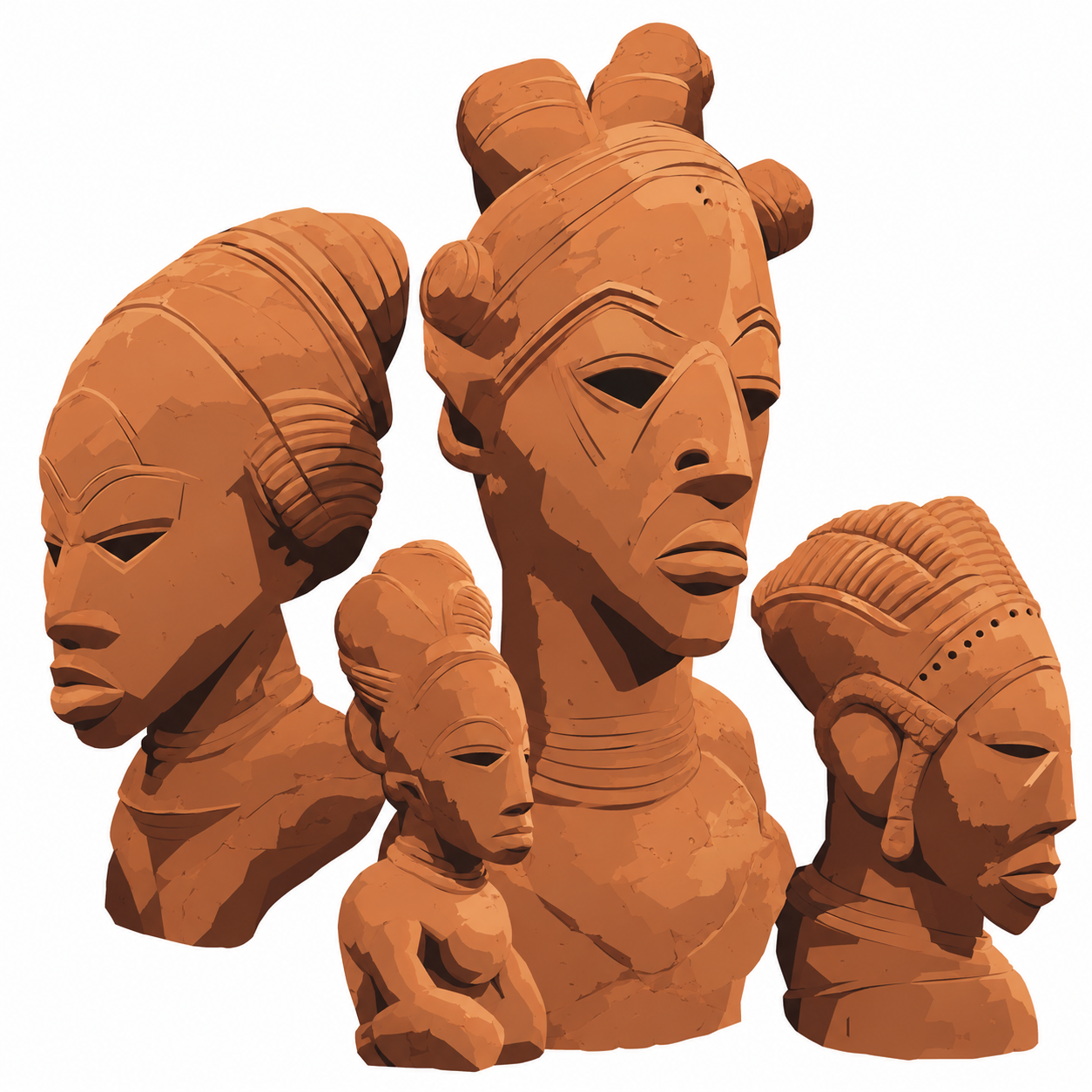
If Nok gives us spectacular objects from ancient Nigeria, Daima gives us something different: time.
At Daima, in present-day Borno State near the Cameroon border, people repeatedly occupied the same location for centuries. Homes were built, abandoned and replaced. Pottery broke and was discarded. Animals were kept and eaten. People were buried. Tools changed. New materials appeared.
Slowly, these activities created a mound containing layer after layer of human occupation.
When archaeologists excavated through those layers in the 1960s, they were effectively moving backwards through centuries of life in northeastern Nigeria. Daima became central to a much larger archaeological study of the Lake Chad region that examined excavated evidence from several sites and surface evidence from dozens more.
The result is one of the clearest archaeological stories of long-term change in ancient Nigeria.
Lakew Chad created a world of its own
To understand Daima, it helps to remove the modern borders from the map.
Today, the Lake Chad Basin is divided among Nigeria, Niger, Chad and Cameroon. Ancient communities living around the lake did not organise their world according to those national boundaries.
Lake Chad and the lands surrounding it formed an interconnected environmental region. Communities adapted to water, seasonal flooding, grasslands, clay plains and sandy areas, while the lake itself changed considerably over time.
Daima stood south of the lake in an environment known as the firki, broad clay plains affected by seasonal water. Archaeological research in the region found that differences between these clay plains and the sandy country farther west had a major influence on where and how people settled.
Geography was not simply the background to Daima’s history. It helped shape it.
A settlement became a mounds
Daima is what archaeologists call a settlement mound.
The idea is simple. Imagine people living in one place for generations. Buildings deteriorate and are replaced. Floors are laid over older floors. Broken pottery, food remains, ash and other material accumulate. New generations continue living above what earlier generations left behind.
Over a sufficiently long period, the ground itself begins to rise.
Daima eventually developed a substantial depth of archaeological deposits. This allowed archaeologists to examine different layers and compare what people were doing during different periods.
Graham Connah’s archaeological work divided the occupation into three broad phases: Daima I, Daima II and Daima III. The divisions are useful for understanding change, but they should not be imagined as three completely unrelated peoples repeatedly replacing one another.
One of Daima’s most important lessons is precisely the opposite.
There was change, but there was also continuity.
Daima I: before iron
The earliest major phase identified at Daima presents a community living without iron.
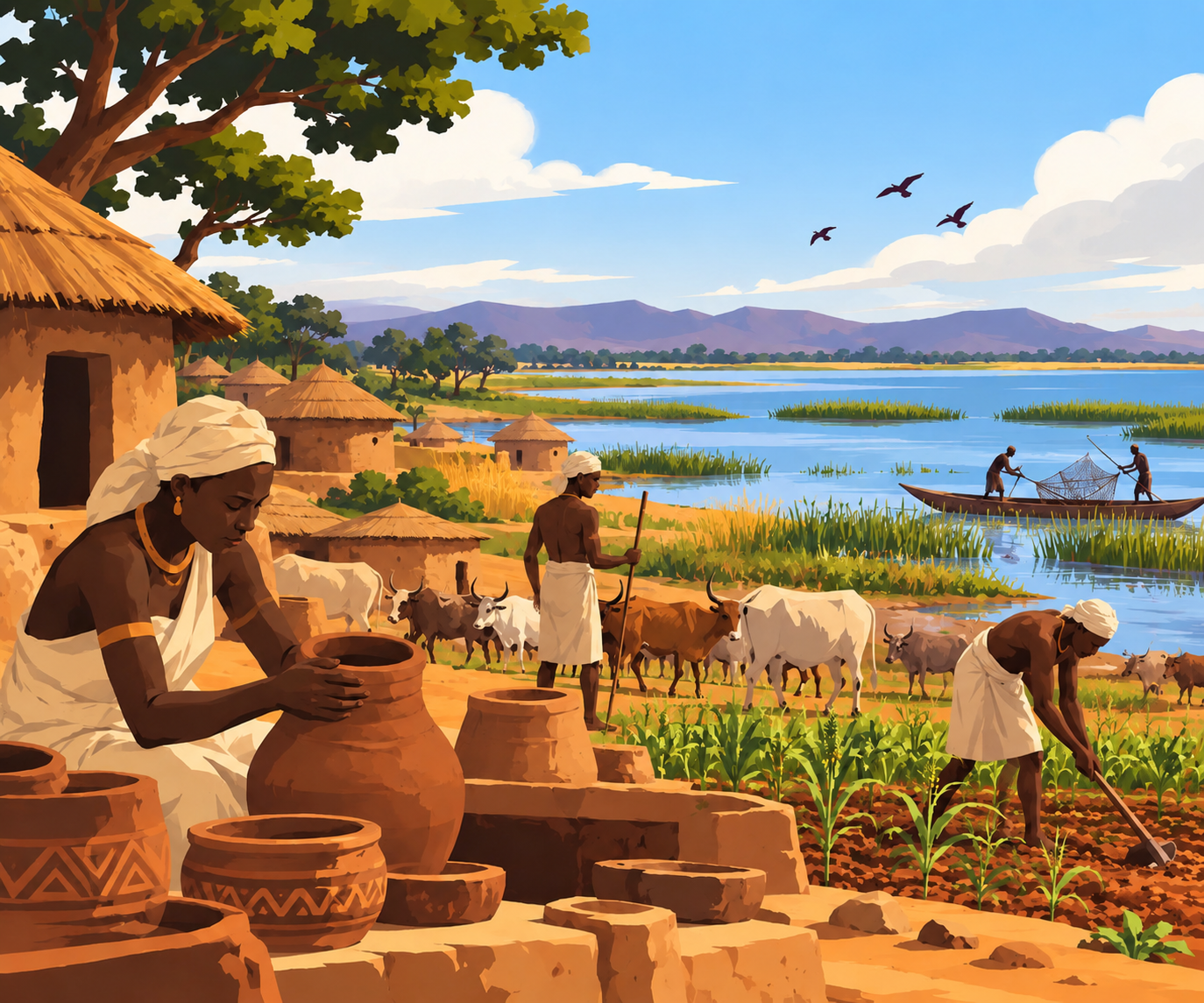
People used stone and animal bone to make different kinds of implements. Archaeological evidence includes polished stone axes and worked bone objects. They also produced pottery and small fired-clay representations of animals.
Livestock were already important.
Evidence from the earliest occupation suggests communities kept cattle as well as sheep or goats. The combination of animal remains and other archaeological material led researchers to describe the early economy as strongly pastoral, although agriculture also became part of the wider story of settlement on the firki plains.
The people of early Daima therefore did not live in some technological emptiness simply because they lacked iron. They already knew how to work stone, bone and clay, manage livestock and survive within the difficult seasonal environment around Lake Chad.
Then a new material entered their lives.
Iron arrived, but the community continued
The transition into Daima II is one of the most important parts of the site.
Iron appeared.
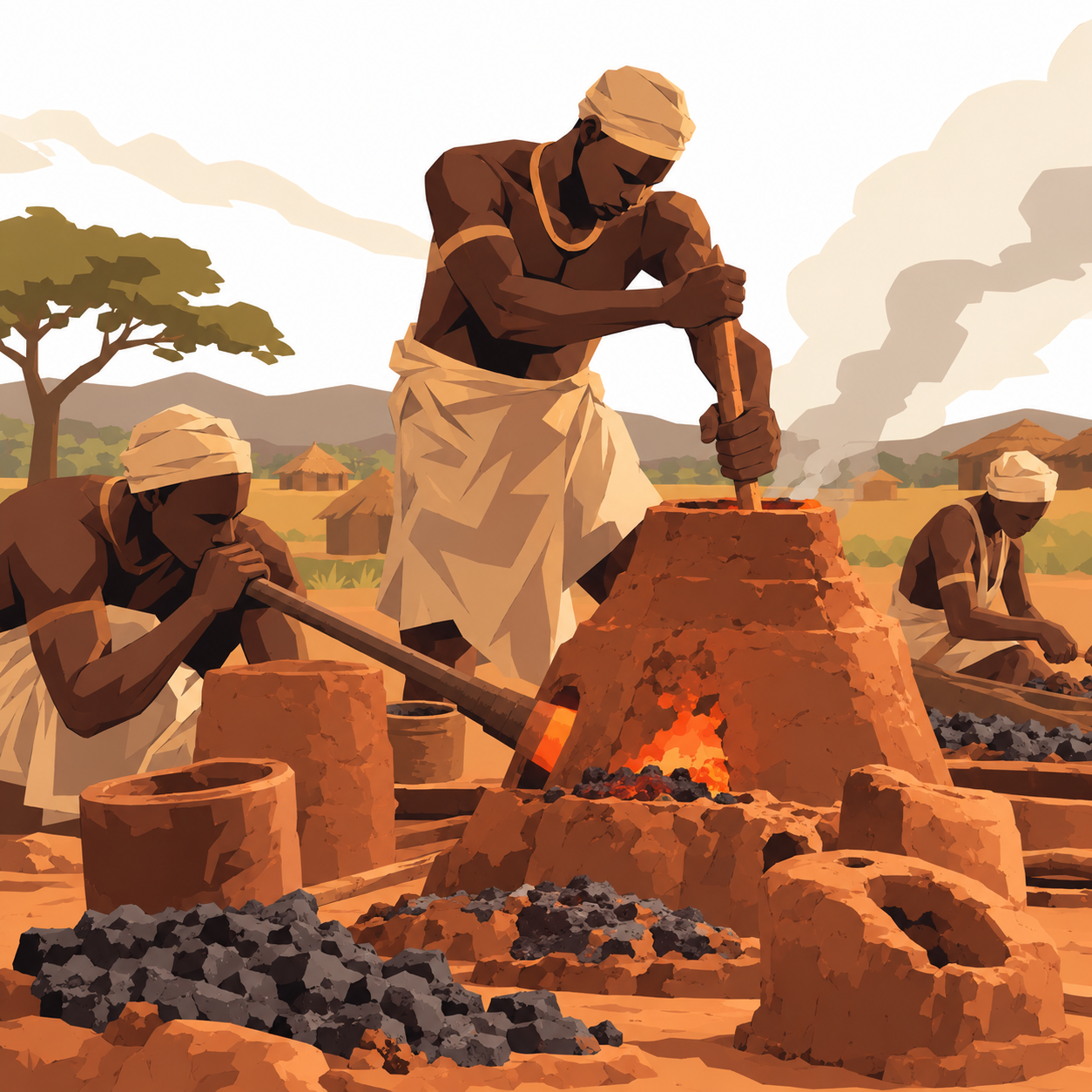
That connects Daima directly with the previous chapter of Openr History. Communities elsewhere in present-day Nigeria had already developed ironworking traditions centuries earlier. At Daima, however, archaeologists could observe what happened as iron entered a settlement with an existing history.
The evidence suggests continuity rather than a dramatic replacement of one population by another.
Iron objects became increasingly common, while stone and bone implements declined. People also constructed circular mud buildings, some associated with floors or surfaces made using pottery fragments.
This makes Daima especially valuable.
At many archaeological sites, researchers may find a Stone Age settlement in one place and a later Iron Age settlement somewhere else. Daima preserves evidence of communities living through that technological transition in the same settlement sequence.
Iron did not create human life at Daima.
It entered a world that already existed.
Farming became increasingly important
The wider archaeological evidence from the firki plains also points towards an important economic transition.
Connah described the regional sequence as showing the possible development of a Late Stone Age pastoralist economy into an Iron Age cereal-cultivating economy.
This should not be understood as livestock disappearing and crops suddenly replacing them. Ancient economies were rarely so neat.
Instead, communities could combine different ways of obtaining food. Cattle, sheep and goats could remain important while cereal cultivation expanded. Fishing and the use of wild resources could also form part of life within the wider Lake Chad environment.
That flexibility mattered in a landscape strongly affected by water and seasonal change.
Daima was becoming a community in which livestock keeping, cultivation and increasingly sophisticated technology could exist together.
Archaeology lets us watch ordinary life changing
One reason Daima matters so much is that its history is not primarily about rulers.
There is no surviving list of Daima kings.
There is no royal chronicle explaining when iron appeared or why people changed the way they built their homes.
Instead, archaeologists reconstruct change from ordinary things.
A piece of pottery can show changes in manufacturing or decoration. Animal bones can help reveal what people ate or kept. Floors can show how houses were constructed. Burials provide clues about beliefs and social differences. Iron objects reveal technological change.
Even rubbish becomes historical evidence.
When thousands of these pieces are studied together and compared across different layers, something unusual becomes possible: archaeologists can watch a community change over centuries.
Daima III became materially richer
By the later phase known as Daima III, roughly placed by Connah within the later first and early second millennium CE, the archaeological record becomes noticeably richer.
Researchers found a wider variety of objects, including pottery, clay beads, animal figurines and cowrie shells. Archaeological features included floors, burials, pits and surfaces constructed with pottery fragments.
The cowries are particularly interesting.
Cowrie shells originated far from inland northeastern Nigeria and circulated widely as valuable objects and, in later African societies, as forms of currency. Their presence at Daima is evidence that communities there were connected to exchange networks extending beyond the immediate settlement.
But perhaps the most striking evidence comes from the dead.
One burial contained thousands of beads and cowries
Burials appear at different points in Daima’s history, but grave goods became more common during the later occupation.
One particularly remarkable burial, belonging to a child or young person, contained more than 4,000 beads and cowrie shells.
The discovery immediately raises questions.
Why was this young person buried with so many objects? Did the ornaments indicate family status? Wealth? Religious significance? Were some of the objects acquired through long-distance exchange?
Archaeology cannot provide confident answers to all of those questions.
What it can show is that later Daima was not socially identical to the settlement that had existed centuries earlier. Material possessions had become more varied, outside connections were visible and differences in burial treatment suggest that social identity could be expressed through objects.
A settlement that began with pastoral communities using stone and bone tools had become part of a considerably more interconnected world.
Daima was connected to something much larger
Daima should not be imagined as an isolated village surrounded by empty land.
Connah’s archaeological programme between 1963 and 1969 investigated a much wider region. The Daima sequence was compared with excavated evidence from Bornu 38, Kursakata, Shilma, Yau, Ajere and Birnin Gazargamo, together with surface evidence from around 70 other sites.
This broader work revealed different patterns of settlement around Lake Chad.
On the firki plains, sites such as Daima helped researchers trace long-term economic and technological change. Farther west, settlements associated with the Yobe River developed along another trajectory.
By the sixteenth century, historical evidence identifies Birnin Gazargamo as an important urban centre. Connah argued that the archaeological development of settlements in the wider region helped provide a much deeper background to the later emergence of urban life and organised states around Lake Chad.
Daima was not itself the capital of a great empire.
Its importance lies partly in showing the much longer human history that existed before famous states dominated the written record.
The Lake Chad region was not waiting for Kanem-Borno
This distinction matters because histories of northeastern Nigeria can easily begin with the great states of Kanem and Borno.
Those states are enormously important and will appear later in Openr History. But beginning the region’s history with kings and empires creates the impression that little happened before centralised states emerged.
Daima tells us otherwise.
Communities had already occupied the region for many centuries. They kept livestock, cultivated crops, made pottery, changed their technologies, buried their dead and participated in increasingly broad networks of exchange.
Political states emerged within landscapes that already had deep human histories.
The people living around Lake Chad did not suddenly appear when written sources began mentioning kingdoms.
Climate and environment kept changing
Lake Chad has never been a completely fixed landscape.
Its shoreline has moved dramatically at different points in its history as rainfall, river flows and climate changed. Areas near water during one period could find themselves much farther from it during another.
That made adaptation essential.
Connah’s research placed the relationship between people and their environment at the centre of the Lake Chad archaeological story. His major 1981 study was appropriately titled Three Thousand Years in Africa: Man and His Environment in the Lake Chad Region of Nigeria.
The archaeological evidence does not show people simply being controlled by their environment.
They responded to it.
They chose settlement locations, managed livestock, cultivated crops, built structures and changed technologies. Different environments around the lake encouraged different patterns of settlement and economic life.
Ancient history here was a continuing negotiation between people and landscape.
Daima eventually stopped growing
No settlement lasts forever in exactly the same form.
The main archaeological sequence at Daima eventually ends during the early centuries of the second millennium CE, although the wider regional sequence documented by Connah continues much later. His broader study produced radiocarbon evidence indicating settlement in the Lake Chad region from the end of the second millennium BCE through approximately the sixteenth or seventeenth century CE.
That distinction is important.
Daima is a site. The Lake Chad archaeological sequence is a region.
The end of major occupation at one settlement does not mean northeastern Nigeria became empty. People moved, new settlements developed and political centres changed.
The historical story was continuing elsewhere.
Daima gives us something kings cannot
Ancient history is often organised around dramatic events.
A ruler conquers another kingdom. A dynasty begins. A capital falls. An army invades.
Daima gives us a different kind of history.
Nobody can identify the year when an ordinary family at Daima first began using an iron object. We do not know the name of the person who made one of its clay animal figures or who decided where a particular house should be built.
But those anonymous lives accumulated.
One generation lived above another until metres of archaeological material recorded centuries of decisions.
That is what makes Daima extraordinary.
It allows us to see history not as one dramatic event, but as slow change across generations.
What we know
Daima was a long-occupied settlement mound in the Lake Chad region of northeastern Nigeria. Excavation revealed a deep sequence showing substantial changes in technology, economy and material culture through time.
The earliest major occupation used stone and bone technology and depended heavily on livestock. Iron subsequently appeared, agricultural activity became increasingly important, settlement practices changed and later layers contained a richer variety of material objects and evidence of wider exchange.
The site formed part of a much larger inhabited landscape around Lake Chad rather than existing in isolation.
What we don’t know
The chronology of individual phases at Daima is not perfectly precise. Some radiocarbon dates and interpretations have produced uncertainty, meaning the boundaries between Daima I, II and III should be treated as approximate rather than exact calendar turning points. Later scholarship has also questioned aspects of the original excavation and dating.
We also do not know what Daima’s ancient inhabitants called themselves, what languages they spoke or exactly how their communities were governed.
Material differences between archaeological layers cannot automatically tell us whether populations migrated, identities changed or the same communities gradually adopted new practices.
Sources
Graham Connah, “The Daima Sequence and the Prehistoric Chronology of the Lake Chad Region of Nigeria,” The Journal of African History, Vol. 17, No. 3 — the principal published study establishing Daima’s role in the archaeological chronology of the Nigerian Lake Chad region.
Graham Connah, Three Thousand Years in Africa: Man and His Environment in the Lake Chad Region of Nigeria, Cambridge University Press, 1981 — the major archaeological study of Daima and the wider Lake Chad settlement sequence.
Later archaeological scholarship on northern Nigeria and the Lake Chad Basin — reassessment of Daima’s later phases, material culture, exchange and its place in the archaeology of northern Nigeria.
Nigerian archaeological scholarship on the Benue-Chad corridor — discussion of Daima’s transition from Late Stone Age settlement to iron-using communities and its evidence for pastoralism, settlement and material culture.