If you travelled through central Nigeria more than 2,500 years ago, you would not find Nigeria. There was no Abuja, Kaduna or Plateau State, no Nigerian borders or colonial administration, and no written record explaining who governed the people living there or even what they called themselves.
What you would find were communities. They cultivated crops, made pottery and used stone tools. Later, they produced iron, while some created large clay sculptures of humans and animals unlike almost anything else known from that period in sub-Saharan Africa. Thousands of years later, pieces of those sculptures began emerging from the Nigerian earth.
Today, archaeologists call the society associated with them the Nok culture. Strangely, that name came from a modern Nigerian village rather than from the ancient people themselves.
It began with something found in a mine
The modern discovery of Nok is partly a story about mining. In 1928, a terracotta head was uncovered during tin-mining operations near the village of Nok, on the edge of the Jos Plateau in central Nigeria. More terracotta objects subsequently appeared from mining areas and other sites across the region.
Another important discovery followed in the 1940s, when a terracotta head was recovered around Jemaa. British archaeologist Bernard Fagg noticed similarities between it and the earlier discovery from Nok and began recognising the objects as belonging to a wider archaeological tradition.
The label Nok stuck, but it does not mean archaeologists discovered an ancient kingdom whose inhabitants called themselves Nok. Modern archaeology named the culture after the village near which one of the earliest recognised objects had been found.
We know what archaeologists call these people. We do not know what they called themselves.
Nok was much bigger than one village
As discoveries accumulated, it became clear that Nok was not simply the artistic tradition of one settlement. Nok-related archaeological material has been found across a broad area of central Nigeria, including territory around and beyond the Jos Plateau.
Modern archaeological work has significantly changed what researchers know about this landscape. Beginning in 2005, researchers from Goethe University Frankfurt and Nigeria’s National Commission for Museums and Monuments carried out an extensive research programme on Nok sites. By the end of the project in 2021, researchers had conducted about 80 excavations and obtained more than 270 radiocarbon dates.
That evidence substantially revised the chronology. Researchers now place the beginning of the wider Nok cultural sequence around the middle of the second millennium BCE, approximately 1500 BCE, with its final phase disappearing around the beginning of the Common Era.
The Nok story therefore spans roughly 1,500 years, beginning more than 3,000 years ago.
The famous sculptures came later
There is an important difference between the beginning of the Nok cultural sequence and the appearance of the famous Nok sculptures. It would be misleading to describe everything from around 1500 BCE onward as the age of Nok terracotta sculpture.
Communities associated with early Nok material were already living in central Nigeria during the second millennium BCE, but current archaeological research places the characteristic large-scale figurative terracotta tradition from roughly 900 BCE onward.
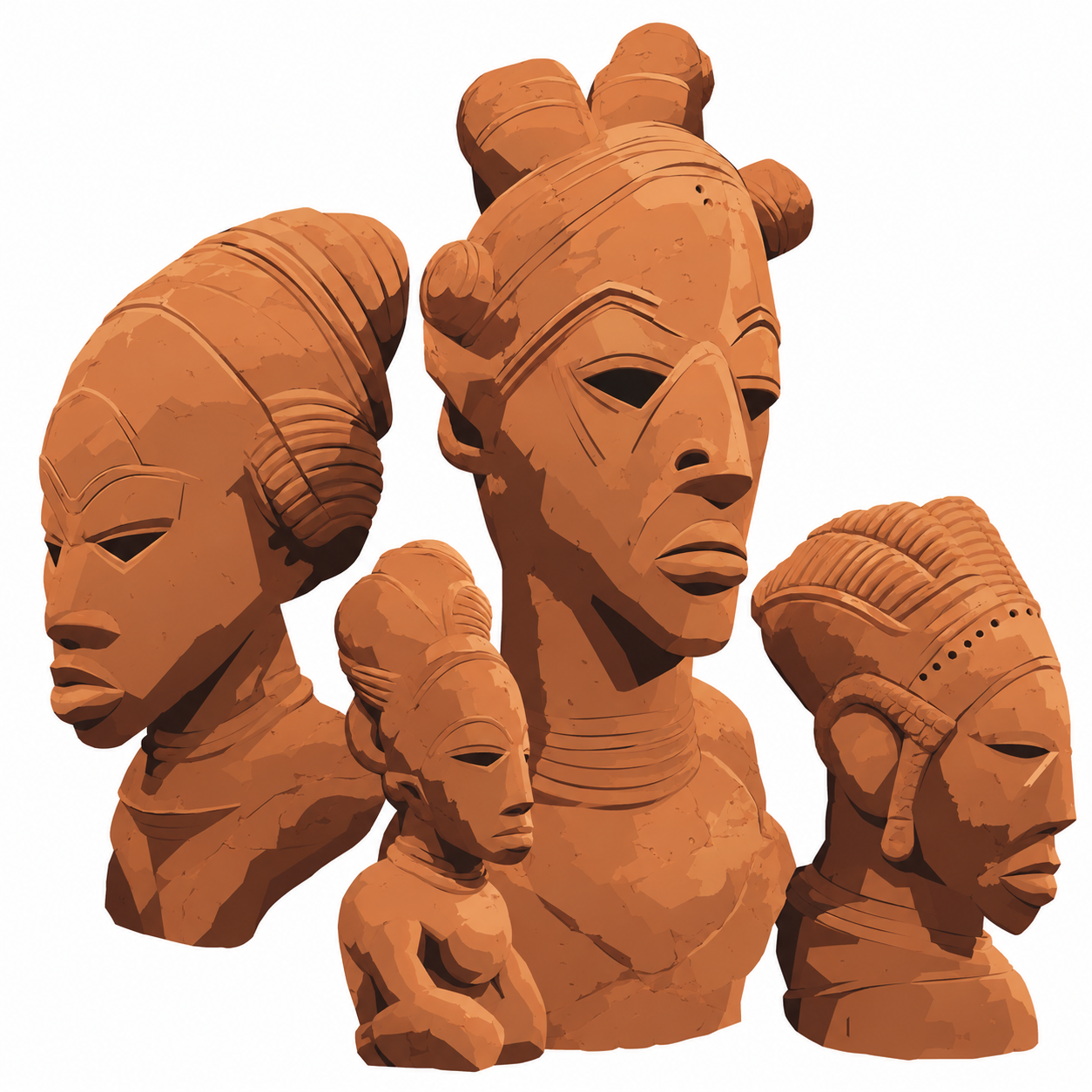
These sculptures are the reason Nok became internationally famous. Many depict human heads or bodies, sometimes with elaborate hairstyles, jewellery and decorative markings. Facial features can include triangular or pierced eyes and carefully shaped mouths and nostrils. Other sculptures depict animals or creatures combining different features.
They were not simply tiny ornaments. Nok produced what researchers describe as the earliest known large-scale figurative sculptural tradition in sub-Saharan Africa. What those sculptures meant to the people who made them, however, is a much harder question.
Why were the figures made?
For decades, this has been one of the biggest mysteries surrounding Nok. Many early terracottas were not recovered through controlled archaeological excavation. Mining, erosion and illicit digging removed objects from their original surroundings, causing researchers to lose valuable information about the contexts in which they had been placed.
Imagine finding a ceremonial crown without knowing whether it came from a palace, grave, shrine or rubbish pit. You would still have the crown, but much of the story explaining it would have disappeared. The same problem affects the interpretation of many Nok objects.
The British Museum notes that many Nok figures were discovered accidentally through mining, erosion or exposure rather than systematic archaeological excavation. Modern excavations, however, have begun changing what researchers know.
At sites such as Pangwari, archaeologists discovered relationships between terracotta deposits, stone-pot arrangements interpreted as graves, pits and evidence of repeated activity. Research suggests that the site changed from a settlement during the second millennium BCE into a place used partly for ritual activities around 800 BCE.
More recent archaeological research has connected some terracotta deposits with mortuary activity, feasting and repeated rituals associated with the dead. Some Nok sculptures may therefore have played roles connected with ancestors, death or ritual practices rather than existing simply as decoration.
Archaeology still cannot tell us exactly whom every figure represented. Describing them automatically as kings, gods or warriors would go beyond what the evidence establishes.
The people behind the sculptures were farmers
The dramatic terracotta figures can distract from something more ordinary but equally revealing: Nok communities had to eat. Archaeobotany, the study of ancient plant remains, has helped researchers reconstruct parts of their everyday lives.
Evidence from Pangwari shows the importance of pearl millet, alongside the fruit of Canarium schweinfurthii, sometimes called African elemi. Researchers describe Nok communities as practising small-scale agriculture within landscapes containing dry forest and woodland.
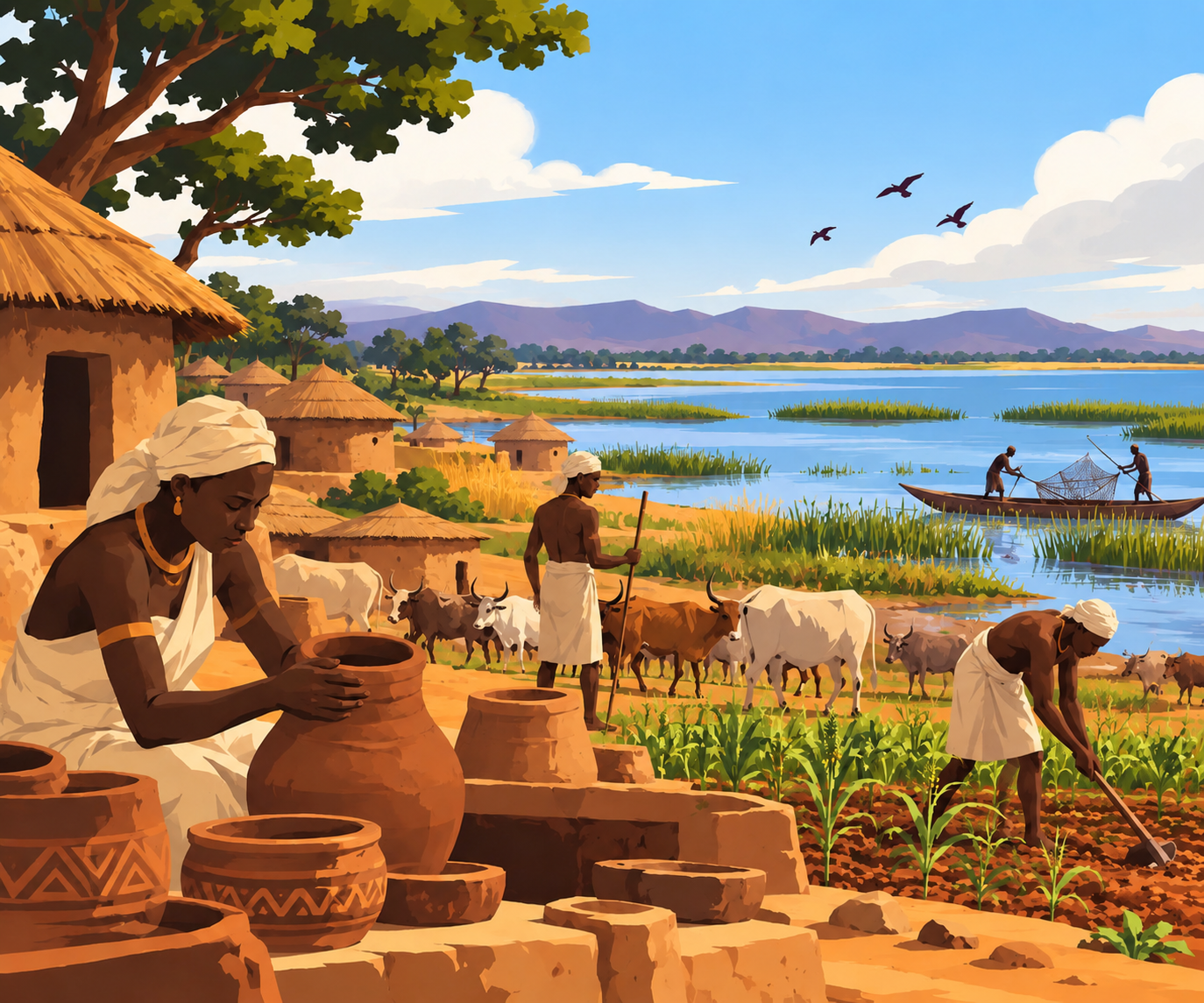
This gives us a more complete picture of the people behind the sculptures. They were not simply mysterious ancient artists. They were communities living on and managing the land, planting crops, gathering useful plants, making pottery and establishing settlements.
Over time, they also adopted another technology that would profoundly change human societies: ironworking.
Nok communities learned to work iron
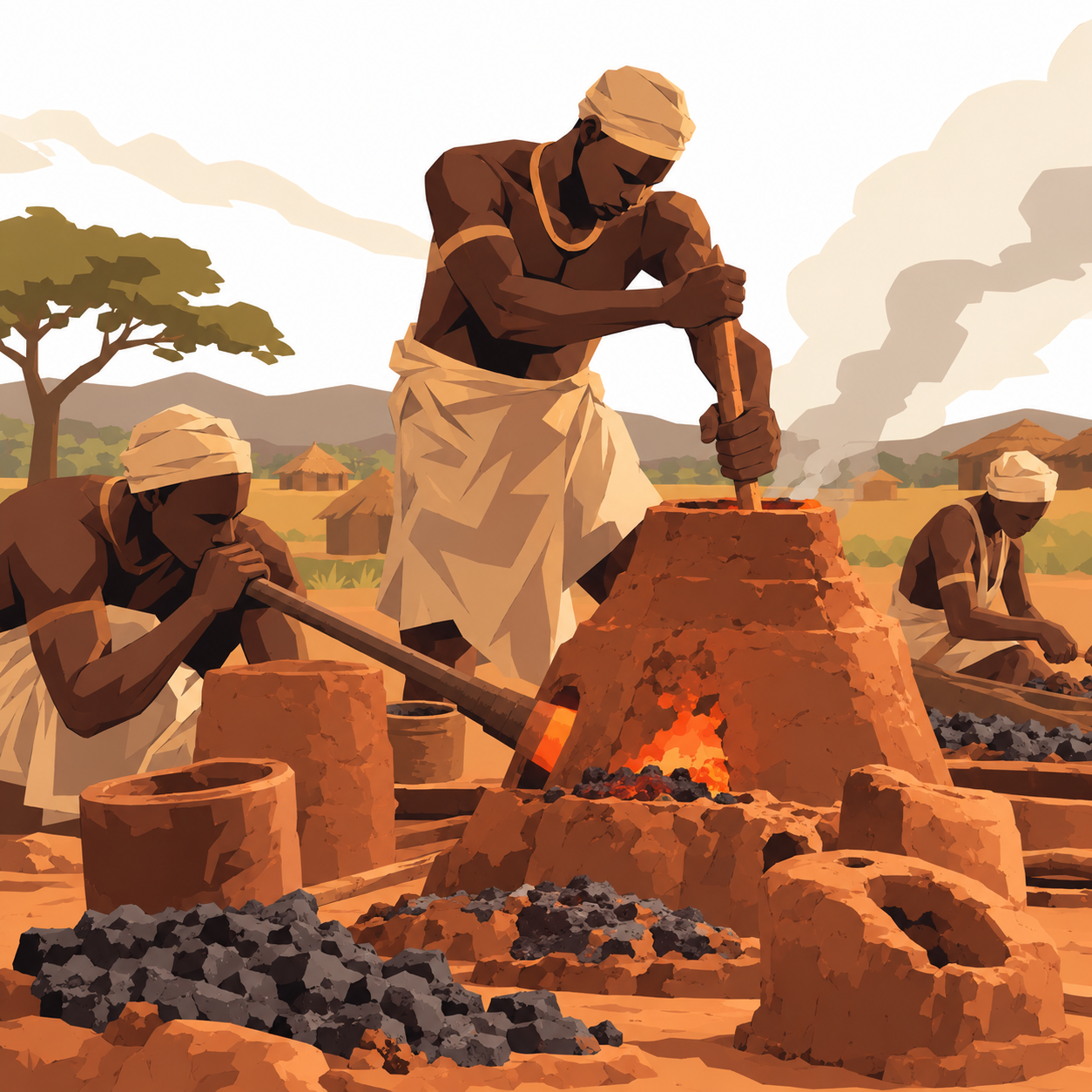
Nok has long been associated with some of West Africa’s early evidence of iron metallurgy. Properly processed, iron could be transformed into durable agricultural tools, implements and other useful objects.
Producing iron, however, required specialised knowledge. Iron-bearing material had to be identified and heated to extremely high temperatures under controlled conditions. Furnaces had to be constructed, fuel prepared and the smelting process understood.
Older descriptions of Nok sometimes connected the appearance of its terracotta sculptures directly with the beginning of iron production. Modern archaeology has complicated that story. Recent research indicates that the characteristic Nok terracotta tradition appears before the earliest presently established evidence for Nok iron production, with iron appearing later in the archaeological sequence.
Researchers therefore caution against assuming that iron technology caused the emergence of Nok sculpture. By the first millennium BCE, however, both had become important features of the archaeological record. The British Museum consequently describes Nok as one of the earliest known centres of both ironworking and figurative terracotta production in sub-Saharan Africa.
Nok was probably not a giant empire
Sophisticated art and iron technology can make it tempting to imagine Nok as a powerful ancient kingdom with a king, capital, palace, army and central government. There is currently no archaeological basis for confidently reconstructing Nok that way.
Recent research instead describes Nok communities as small-scale farmers living in dispersed settlements or homesteads. Archaeologists have found evidence of specialised production and a shared material and ritual culture across a large territory, but not the evidence of centralised political hierarchy needed to confidently describe Nok as a kingdom or empire.
No Nok palace has been identified, no Nok king list survives, no capital city has been established and there are no known Nok texts explaining how their political system worked.
This makes Nok interesting for another reason: complex culture does not require an empire. Communities spread across a large region could share artistic styles, technologies and ritual practices without necessarily answering to one monarch.
What did a Nok settlement look like?
Reconstructing Nok settlements is more difficult than studying their terracotta sculptures. Clay sculptures and pottery can survive underground for thousands of years, while buildings made largely from organic materials are much less likely to survive.
At Pangwari, extensive excavation has helped archaeologists understand repeated use of the landscape between approximately 1500 and 500 BCE. The evidence points towards dispersed rather than densely urban settlement.
We should therefore not imagine ancient Nok as another Benin City or Ile-Ife appearing more than a thousand years early. The archaeological picture is different: farming communities distributed through the central Nigerian landscape, connected by broadly shared pottery traditions, technologies and ritual practices.
Among those communities were craftspeople capable of turning clay into remarkable representations of the human body.
The faces tell us something, but not everything
Nok heads are often immediately recognisable because their creators paid extraordinary attention to human appearance. Hairstyles could be elaborate, jewellery and ornaments appear frequently, and some figures show marks on their faces or bodies. Eyes and nostrils were often pierced through the clay.
These details suggest that appearance mattered, but interpreting exactly what they meant is difficult. A hairstyle might represent status, fashion, ritual identity or something else. Jewellery could indicate wealth or social role, while a distinctive figure might depict an ancestor, respected person or symbolic being.
We cannot simply look at a sculpture and know its meaning. This is one of the central challenges of prehistoric archaeology: objects survive more easily than explanations.
We do not know what language Nok people spoke
Modern central Nigeria contains many ethnic and linguistic communities, making it tempting to identify Nok automatically as the ancestor of a particular present-day Nigerian people. Archaeology does not currently allow such a simple conclusion.
Nok describes an archaeological culture identified through patterns in material remains. It is not a recorded ethnic name. There are no surviving Nok writings identifying their language.
More than two thousand years of migration, intermarriage, language change, population movement and political transformation also separate Nok from modern Nigeria. That does not mean Nok people left no descendants. It means we cannot confidently draw a straight ethnic line from archaeological objects to a modern identity without stronger evidence.
Then Nok disappeared from the archaeological record
For a culture that lasted so long, its ending is surprisingly quiet. After centuries of recognisable Nok pottery, terracottas and settlement activity, the archaeological pattern begins to change. The elaborate figurative tradition disappears, characteristic pottery disappears and later communities in the region show different material traditions.
Current research places Nok’s decline in the final centuries BCE, with its characteristic archaeological culture disappearing around the beginning of the Common Era. Researchers have investigated environmental change, agricultural practices, population movement and changes in settlement and subsistence, but there is no surviving record explaining exactly what happened.
Even the word disappeared needs qualification. People did not necessarily vanish from central Nigeria. What disappears is the particular collection of archaeological characteristics by which researchers recognise Nok culture.
Their descendants may have changed how they lived, mixed with other populations, moved elsewhere or adopted different cultural practices. An archaeological culture can disappear without its people simply vanishing.
Nok was discovered twice
There is another way to think about Nok history. The first story happened thousands of years ago, when the communities themselves lived across central Nigeria. The second began in the twentieth century, when miners uncovered terracottas and archaeologists gradually began reconstructing the world that produced them.
Scientists dated objects and archaeological layers, excavations revealed settlements, plant remains showed what people ate, and evidence of furnaces and iron production revealed technological change. The contexts surrounding terracotta fragments also began providing clues about how some sculptures might have been used.
Each generation of research has changed the story. This is why older accounts of Nok sometimes differ substantially from newer ones. Museum descriptions may date securely excavated characteristic Nok objects to parts of the first millennium BCE, while the much larger modern research programme recognises a wider cultural sequence beginning centuries earlier.
Those findings are not necessarily contradictory. One can describe the date of particular objects while the other describes the broader archaeological culture.
Looting has made that history harder to understand
Nok terracottas eventually became highly desirable objects in the international antiquities market, creating a serious problem for archaeology. An illegally excavated sculpture may still look impressive in a private collection or museum, but removing it without documenting exactly where and how it was found destroys archaeological information.
Its soil layer, relationship with nearby pottery, connection to structures and possible association with burials or ritual sites can all be lost. For Nok, this is especially damaging because so many fundamental questions remain unanswered.
A terracotta head is art. A terracotta head properly excavated alongside its surrounding evidence is history. This is one reason archaeological preservation matters.
Nok did not simply become Ife or Benin
Another tempting version of Nigerian history presents a simple line of succession: Nok came first, Nok became Ile-Ife, Ife influenced Benin, and therefore later Nigerian sculptural traditions descended directly from Nok.
The evidence is not that straightforward. There are substantial chronological and archaeological gaps between the end of the characteristic Nok tradition and the later flourishing of artistic centres such as Ile-Ife.
Similarities can be studied, and populations across the region undoubtedly interacted and changed over centuries. But current evidence does not justify presenting Nok as the proven direct ancestor of every later Nigerian artistic tradition.
Nok deserves to be understood on its own terms. It does not need Benin or Ife to make it important.
So what exactly was Nok?
Nok was a long-lasting archaeological culture of central Nigeria, beginning around the middle of the second millennium BCE and disappearing around the beginning of the Common Era. Its communities practised agriculture, made distinctive pottery, later produced iron and created an extraordinary figurative terracotta tradition.
They also shared cultural and ritual practices across a large geographical area. But current evidence does not establish a Nok empire, monarchy or centralised state. We do not know what these people called themselves, what language they spoke or precisely how their political life was organised.
What survives is what they left in the earth. That is enough to establish something remarkable: more than two thousand years before modern Nigeria existed, communities in its central region were already developing distinctive technologies, farming systems, artistic traditions and ritual practices of their own.
What we know
Archaeological evidence places the wider Nok cultural sequence from approximately the middle of the second millennium BCE to around the beginning of the Common Era. Its characteristic large-scale terracotta tradition became widespread during the first millennium BCE, while iron production subsequently appears in the archaeological record.
Research points towards farming communities living largely in dispersed settlements rather than a demonstrated centralised empire. Their material remains show shared artistic, technological and ritual traditions across a considerable area of central Nigeria.
What we don’t know
We do not know what Nok people called themselves, what language they spoke, whether they considered themselves one people, precisely how their political life was organised, whom every terracotta represented or exactly why the characteristic Nok archaeological tradition ended.
We also cannot responsibly identify Nok as the direct ancestor of a particular modern Nigerian ethnic group without stronger evidence.
Sources
Gabriele Franke, “The Archaeology of Nok Culture in Nigeria (2nd/1st Millennium BCE)”, Oxford Research Encyclopedia of African History — synthesis of Nok chronology, settlement, terracotta production, ironworking and ritual evidence. Reference link
Katharina Neumann and colleagues, “Pits, Pots and Plants at Pangwari — Deciphering the Nature of a Nok Culture Site,” Azania: Archaeological Research in Africa — archaeological evidence concerning settlement, agriculture and ritual activity at Pangwari. Reference link
Alexa Höhn and colleagues, “A Question of Rite—Pearl Millet Consumption at Nok Culture Sites, Nigeria,” Vegetation History and Archaeobotany — archaeobotanical evidence and findings from the Goethe University–National Commission for Museums and Monuments Nok research programme. Reference link
Gabriele Franke, “A Chronology of the Central Nigerian Nok Culture — 1500 BC to the Beginning of the Common Era,” Journal of African Archaeology — research establishing the expanded chronology of Nok culture. Reference link
British Museum, Nok collection and research — documentation of Nok discoveries, terracotta objects, archaeological context and the geographic distribution of finds. Reference link