The previous chapters of Openr History took us through the ancient communities of Nok, the development of ironworking, life around Lake Chad, Kanem-Borno and the rise of the Hausa states.
Now the story moves southwest.
Here, in present-day Osun State, lies Ile-Ife.
For Yoruba people, Ife occupies a place that archaeology alone cannot explain. Oral traditions describe it as the place where the world began and from which important royal dynasties emerged.
Archaeology approaches the city differently.
It digs beneath houses, compounds and sacred places. It examines pottery, glass, pavements, sculptures and workshops.
And what it has uncovered confirms something remarkable.
Long before the rise of many later Yoruba kingdoms, Ife had become a major urban, political, artistic and economic centre. The British Museum places its development as a city-state from around AD 800 and its major commercial flourishing between roughly 1100 and 1400.
But Ife’s story begins before its most famous artworks.
A city grew in the forest
The environment of southwestern Nigeria was very different from the open savanna surrounding Kano or the dry landscapes north of Lake Chad.
Ife developed within the forest zone.
That did not isolate it.
Communities across the region farmed, produced crafts and exchanged goods. Settlements expanded and interacted, creating the foundations for increasingly complex societies.
Over time, Ife became unusually important.
Its population grew. Different areas of settlement developed. Political and religious institutions became more elaborate, and the city became associated with an Ooni, the title still used by Ife’s traditional ruler.
Archaeology reveals that this was not simply a ceremonial centre.
People were manufacturing things there.
And some of those industries were technologically sophisticated.
Ife’s glassmakers changed what historians thought about Africa
For a long time, archaeologists assumed that much of the glass used for beads in sub-Saharan Africa had originated elsewhere.
Research at Igbo Olokun, an archaeological site within Ile-Ife, changed that picture.
Excavations uncovered thousands of glass beads alongside crucibles and waste produced during glassworking.
The evidence dated the main period of glass production there to approximately the 11th to 15th centuries.
Chemical analysis then revealed something even more important.
Researchers identified distinctive high-lime, high-alumina glass whose composition differed from better-known glassmaking traditions elsewhere. Excavations recovered more than 12,000 beads as well as kilograms of production debris, while analysis indicated that local craftspeople were probably producing glass from raw materials available in the region.
Later discoveries of semi-finished glass provided what researchers described as the first evidence for autonomous primary glass production in sub-Saharan Africa.
This means Ife was not simply receiving finished glass from distant traders.
Its craftspeople knew how to make it.
The beads travelled
Producing thousands of beads makes little sense without people who wanted them.
Glass beads could serve as ornaments, symbols of prestige and items of exchange.
Research indicates that Ife’s distinctive glass was produced on a substantial scale during the city’s classical period.
That tells us something important about the city.
Ife had specialists.
Some people could devote considerable skill and time to manufacturing objects rather than producing all of their own food.
That usually requires a larger economic system capable of supporting them.
Raw materials had to arrive.
Workers needed food.
Finished products needed customers.
The glass workshop therefore reveals more than technology.
It reveals an economy.
But glass would not become the discovery that made Ife internationally famous.
Human faces would.
Ife’s artists created extraordinary portraits
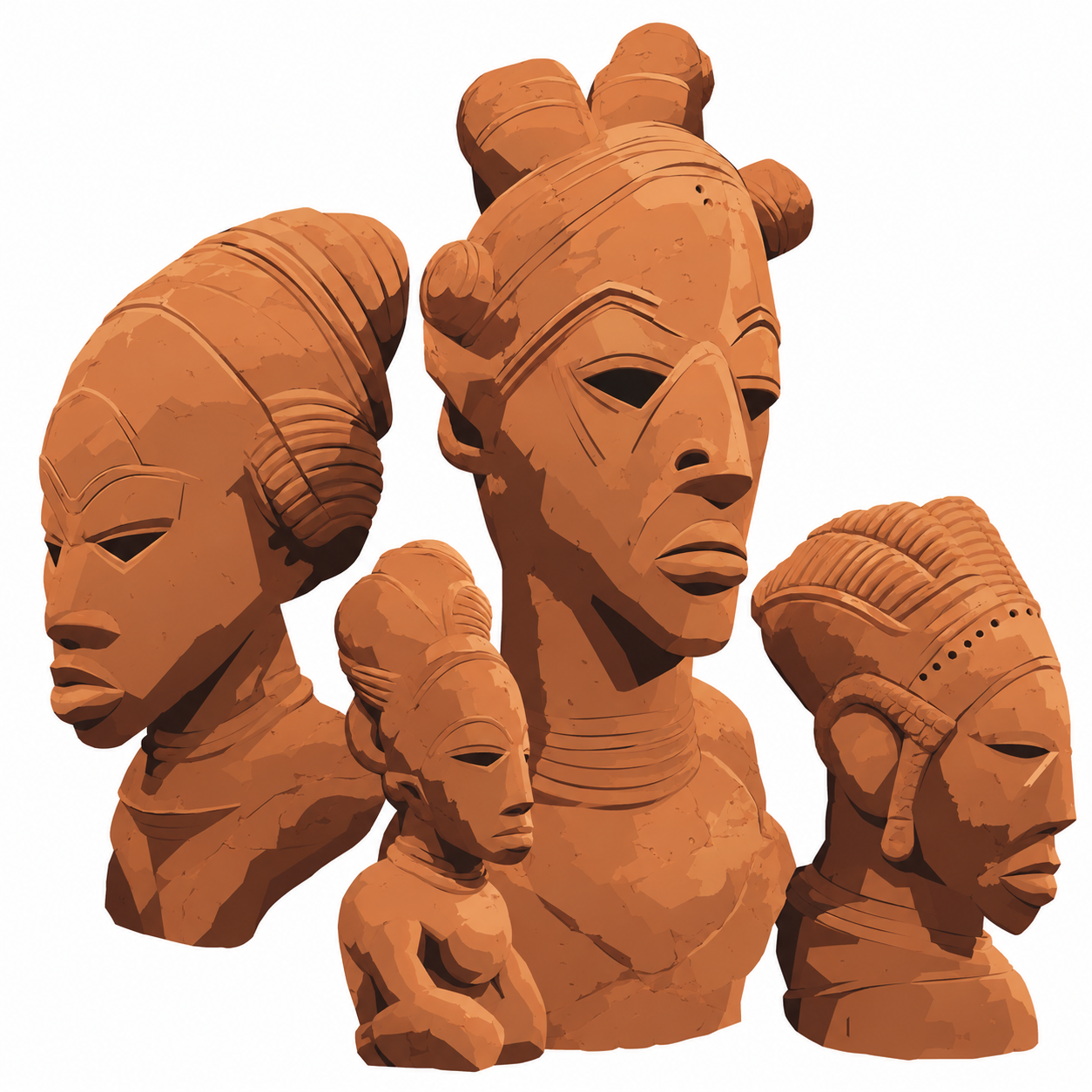
Among the most remarkable surviving works from medieval Africa are the sculptures produced at Ife.
Artists worked in several materials, including terracotta, copper and brass.
Many representations of human beings are strikingly naturalistic.
Faces are carefully proportioned. Lips, eyes and ears are precisely modelled. Some heads bear detailed crowns or elaborate hairstyles. Others have fine vertical lines running down their faces.
The sophistication of these works became dramatically clear outside Nigeria after discoveries during the early twentieth century.
One famous group was uncovered at Wunmonije Compound near the Ooni’s palace in 1938.
Five copper heads, twelve brass heads and part of a figure were found during building work.
One surviving brass head now held by the British Museum is dated approximately to the 14th or early 15th century. It was created using the lost-wax casting technique, in which a wax model helps form the mould into which molten metal is eventually poured.
The technical achievement was extraordinary.
So was the reaction to it.
Some Europeans refused to believe Africans had made them
When German ethnologist Leo Frobenius encountered Ife artworks during a visit in 1910, he recognised their remarkable quality.
But he struggled to accept their actual origin.
The naturalism appeared so inconsistent with racist European assumptions about African civilisation that Frobenius connected the works with the mythical lost civilisation of Atlantis.
Later reactions to Ife art produced similar comparisons with ancient Greece and Rome.
The assumption underneath them was revealing.
If the art was extraordinarily sophisticated, some outsiders believed that its creators could not simply have been African.
Archaeology proved otherwise.
The sculptures belonged to Ife’s own artistic tradition.
The British Museum now describes Ife sculpture as one of the great achievements of African art and culture.
The mystery was never how some lost Mediterranean civilisation reached Nigeria.
The error was assuming Nigerians could not have created the works themselves.
These faces may not be portraits in the modern sense
The realism of the sculptures creates another temptation.
We want to give the faces names.
Some heads wear crowns or elaborate beadwork, suggesting connections with royalty. One famous brass head’s complex beaded crown has led to suggestions that it represented an Ooni.
But archaeology cannot confidently identify most of these people.
We do not know whether every naturalistic head depicts one specific individual exactly as that person looked.
Some may represent rulers.
Some may represent ancestors or other important figures.
Some may have served ceremonial purposes that researchers do not fully understand.
Naturalism does not automatically equal portraiture.
What is certain is the extraordinary control Ife’s artists had over clay and metal.
Terracotta tells an even broader story
Metal heads are now among Ife’s most famous objects, but metal represents only part of its artistic tradition.
Terracotta sculpture was also widespread.
Clay was more accessible than copper alloys and could be modelled into an enormous variety of forms.
Archaeologists have recovered human heads, complete or partial figures and other terracotta objects at different locations around Ife.
Together with stone and metal sculpture, these discoveries reveal a city with multiple artistic traditions rather than one workshop producing one type of object.
Art was embedded within a larger cultural world.
And the city itself was becoming visually distinctive in another way.
Parts of Ife were covered with decorated pavements
Archaeologists have also uncovered distinctive pavements made from pottery fragments or ceramic pieces set into the ground.
Some were arranged in elaborate patterns.
These pavements have been found in locations associated with important compounds and other areas of the ancient city.
They required labour.
Someone had to produce the ceramics, prepare the ground and carefully arrange the pieces.
Like city walls, palaces or monumental architecture elsewhere, decorated pavements show that communities were investing resources in reshaping urban space.
Medieval Ife was not simply a collection of houses surrounded by forest.
People were deliberately constructing a city.
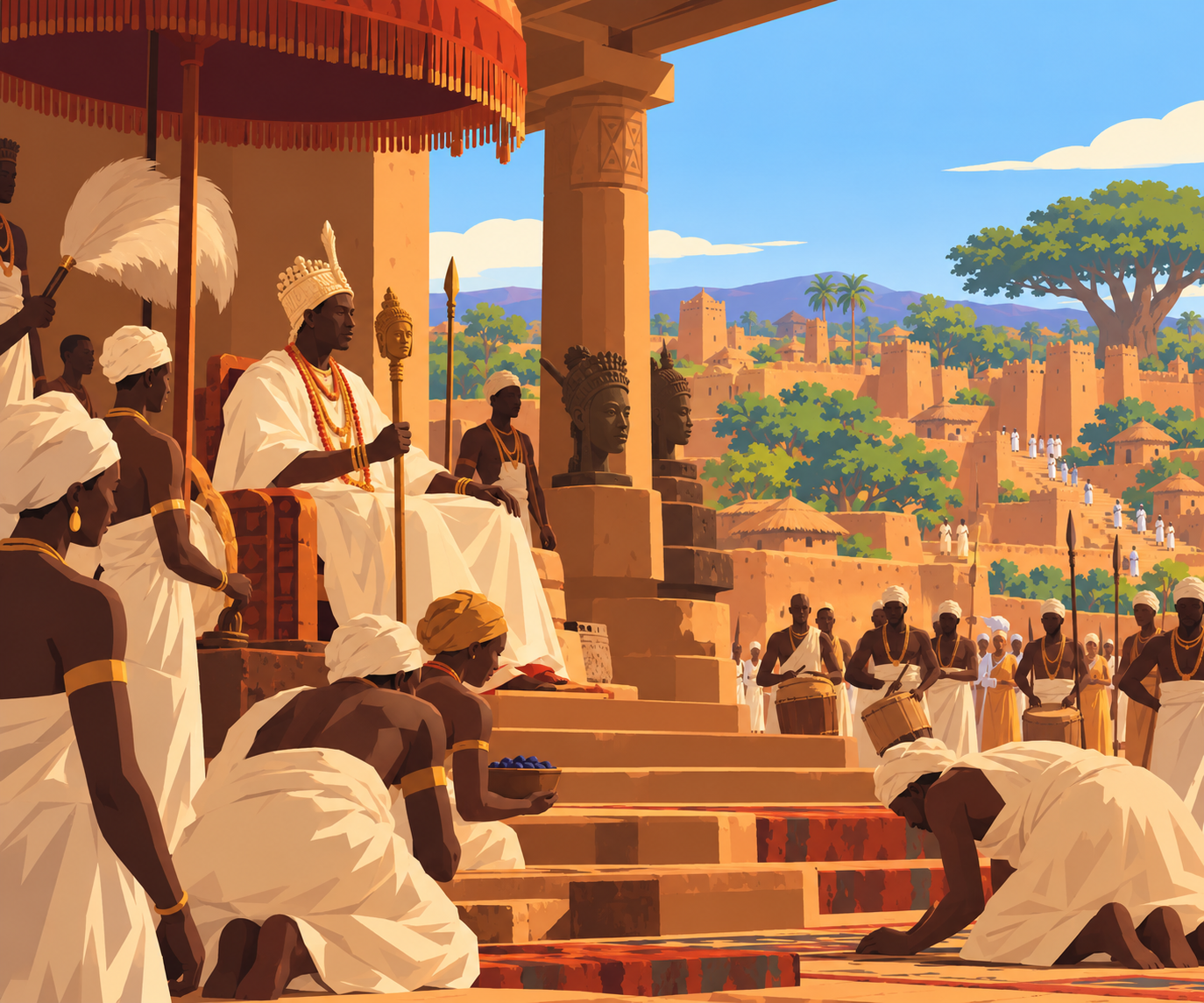
Ife became sacred as well as political
Archaeology can show us workshops and pavements.
Oral tradition gives us another Ife.
In Yoruba traditions, Ilé-Ifẹ̀ occupies a foundational position in the history of the world.
Different traditions tell the story in different ways, but figures including Oduduwa and Obatala occupy central places in accounts of creation, settlement and political origins.
Oduduwa is particularly important to traditions of Yoruba kingship.
Royal dynasties across several Yoruba kingdoms trace political ancestry or legitimacy to Ife and Oduduwa.
These traditions cannot simply be converted into archaeological dates.
That is not what they are.
They preserve religious ideas, political relationships, collective memories and explanations of how societies understood themselves.
For Yoruba communities, therefore, Ife exists simultaneously in several kinds of history.
There is archaeological Ife.
There is political Ife.
And there is sacred Ife.
They overlap without being identical.
Oduduwa is historical, sacred and difficult to date
Trying to turn Oduduwa into a conventional modern biography creates problems.
Traditions disagree about aspects of his origin and life.
In some accounts he arrives at Ife.
In others, his role is inseparable from sacred narratives concerning the establishment of the world and Yoruba civilisation.
What matters historically is that traditions surrounding Oduduwa became fundamental to political legitimacy.
Kings in different Yoruba states could trace descent to Ife.
That created a shared political language even when those states were independent and sometimes fought one another.
Ife therefore exercised an influence that was not simply military.
A kingdom did not have to be governed directly from Ife to recognise Ife as a source of sacred or dynastic authority.
That kind of influence can survive long after political power changes.
Ife was connected to a wider commercial world
Its glass industry already demonstrates that Ife possessed substantial production networks.
Other evidence shows that the city participated in wider systems of exchange.
The British Museum describes Ife between approximately 1100 and 1400 as a major commercial centre with access to trade networks associated with the Niger.
Trade moved more than luxury objects.
It connected craftspeople to raw materials.
It connected rulers to wealth.
It connected communities to new ideas and technologies.
Ife’s rise therefore occurred within a broader West African world in which cities and states were increasingly connected.
Kano was expanding in the north.
Kanem-Borno dominated important networks around Lake Chad.
Mali had become a major power farther west.
And in southwestern Nigeria, Ife was producing objects unlike anything else known from the region.
Ife’s political dominance did not last forever
Great cities change.
By around the 15th century, the period associated with Ife’s most famous artistic production was coming to an end.
That does not mean the city disappeared.
Instead, political and economic power within the wider region was shifting.
Other Yoruba centres developed.
And to the southeast, another kingdom was becoming increasingly powerful: Benin.
Traditions preserved in Benin and Ife connect their royal histories, although the exact historical relationship between the two has been debated.
What archaeology makes clear is that Ife’s sophisticated metalworking tradition predates the famous later brass traditions of Benin.
The British Museum places both within a broader medieval West African history of metal casting that also includes Igbo-Ukwu.
This does not mean Ife simply “became” Benin.
They were distinct political and cultural centres.
Influence is not the same as identity.
Ife did not disappear when its classical age ended
This is perhaps the biggest mistake a timeline can create.
Historians may describe a city’s “golden age” and then move to the next civilisation.
The people living there do not vanish when the textbook changes chapter.
Ife remained.
Its Ooni continued to occupy an important sacred position.
Its religious significance endured.
Its traditions remained central to Yoruba understandings of origin and kingship.
The city exists today.
Modern Ile-Ife therefore sits directly above and beside its ancient past.
The same landscape contains archaeological sites, sacred spaces, homes, roads, universities and modern neighbourhoods.
Few places demonstrate more clearly that Nigerian history is not made entirely of dead civilisations.
Sometimes the ancient city is still a living city.
What we know
Ile-Ife developed into an important urban centre during the late first and early second millennia CE and reached a particularly significant period of artistic and commercial activity between roughly the 11th and 15th centuries.
Its craftspeople produced sophisticated terracotta, copper and brass sculpture.
Archaeological research at Igbo Olokun also demonstrates that craftspeople in Ife were producing glass locally. The evidence includes thousands of beads, crucibles, manufacturing debris and semi-finished glass.
Ife became a major political and sacred centre whose significance extended far beyond the city itself.
What we don’t know
We cannot identify most of the people represented in Ife’s famous sculptures.
Their exact functions also remain uncertain.
Similarly, archaeology cannot prove every detail preserved in Yoruba creation and dynastic traditions.
We should not force oral tradition and archaeology to say exactly the same thing.
One can preserve sacred and political memory while the other reconstructs physical changes through objects, structures and dates.
Important questions also remain about the precise organisation of Ife’s government, the relationships between different parts of the ancient city and how its political influence changed over time.
Research continues.