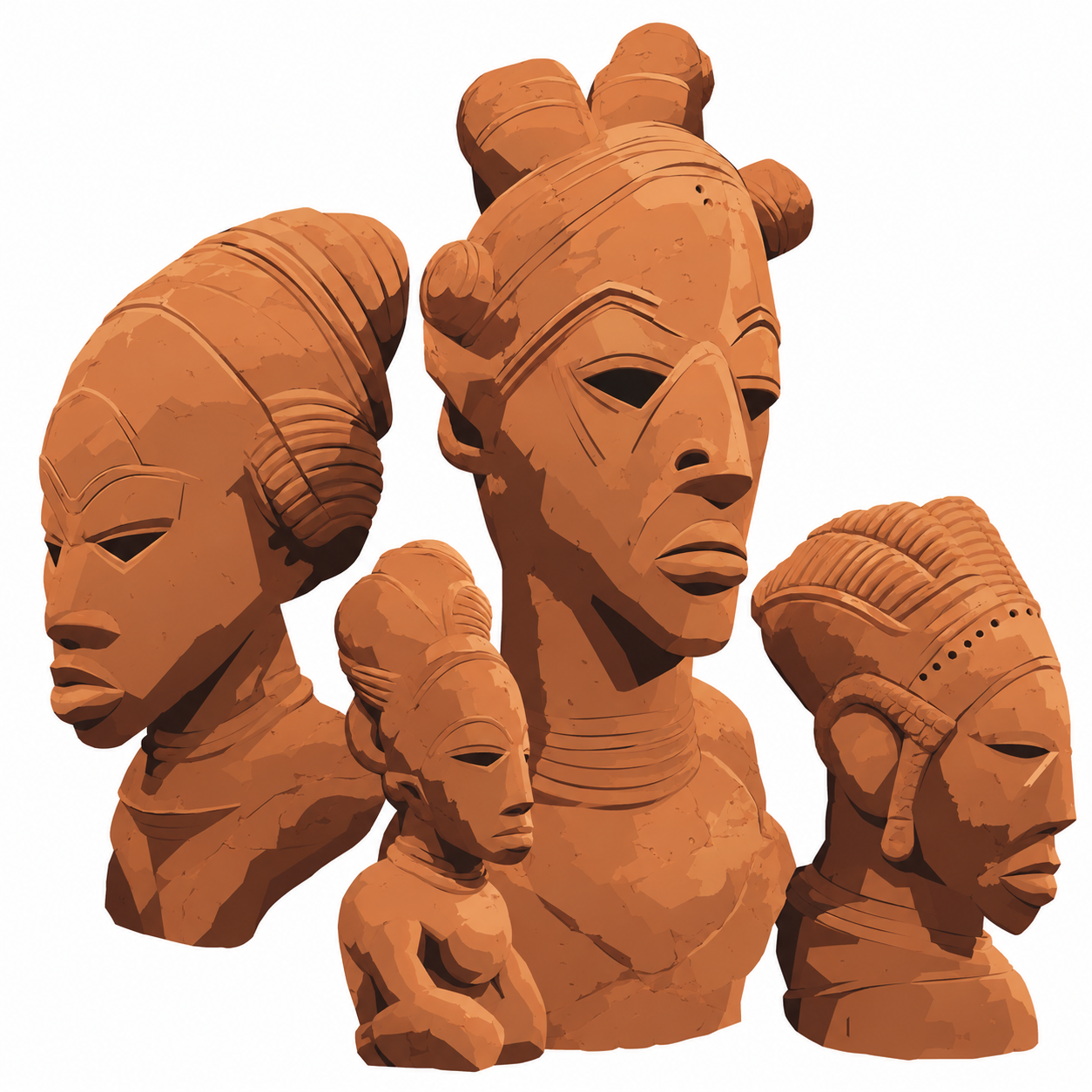
The previous chapter of Openr History ended at Daima, where archaeology shows generations of people living around Lake Chad long before the region became famous for kings and empires.
The next part of the story changes our evidence.
Written records begin to appear alongside archaeology and oral traditions. Rulers acquire names. Dynasties can be traced. Political struggles become clearer. Trade connects the Lake Chad region with North Africa and other parts of the continent.
Out of this world emerged Kanem, one of the most important states in African history.
Its political tradition would later shift west of Lake Chad and become centred in Borno, giving historians the combined name Kanem-Borno.
The state changed enormously during its long existence. It should not be imagined as one empire with the same borders, capital and institutions for a thousand years.
What survived was a political tradition capable of rebuilding itself.
The kingdom began east of Lake Chad
Kanem developed northeast of Lake Chad, largely in territory that is now part of Chad.
Its precise origins remain difficult to reconstruct. Written sources become more useful from around the late first millennium and early second millennium CE, while oral traditions and later chronicles preserve accounts of earlier rulers.
Historians therefore have to combine sources that were created at different times and for different purposes.
What can be said more confidently is that by the end of the first millennium CE, increasingly centralised political systems were emerging in the wider region. Historians Toyin Falola and Matthew Heaton place the growing power of Kanem and Borno within a broader transformation occurring across the Sahel from around the eleventh century.
Kanem was developing in a strategic position.
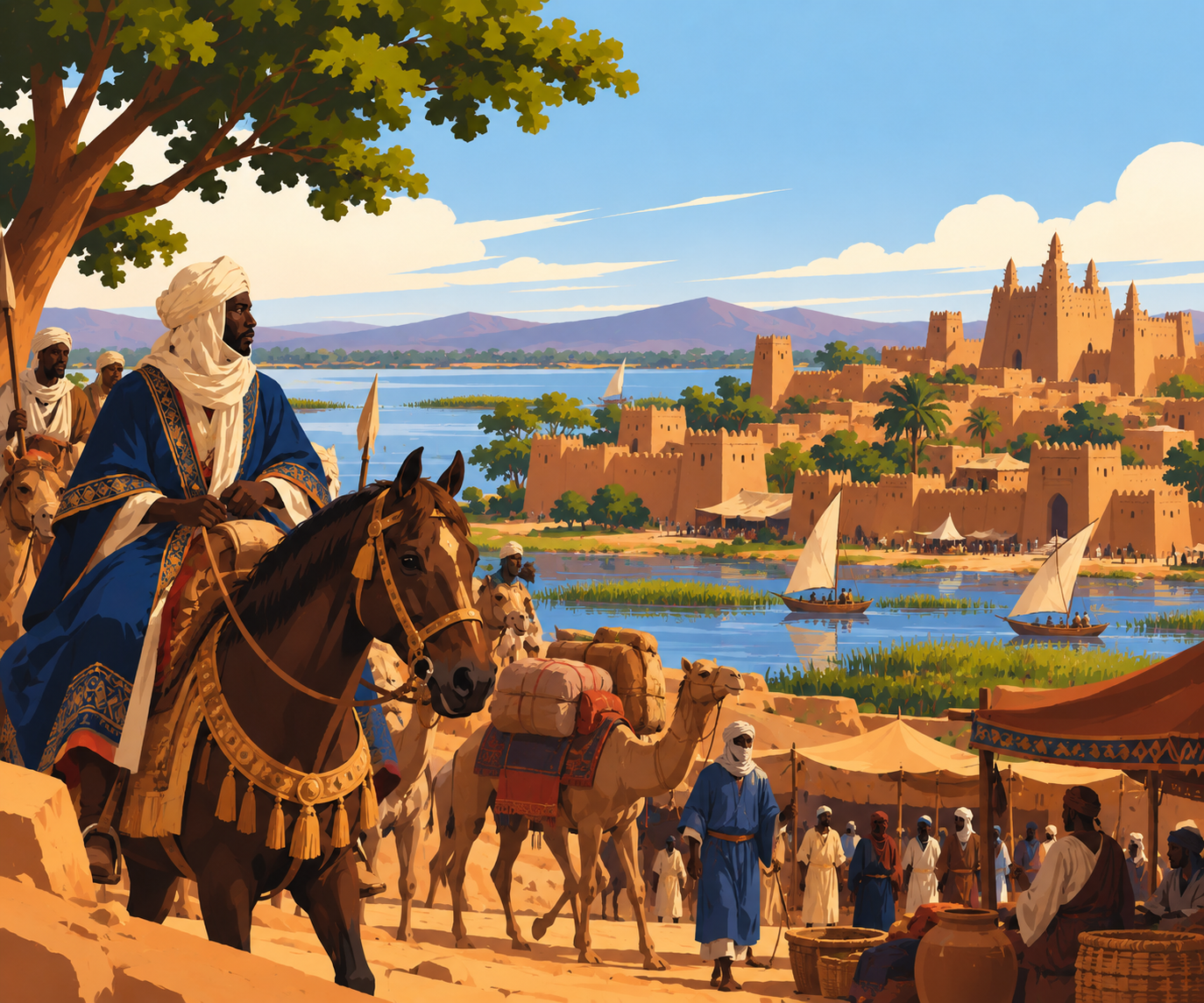
To its south and west lay the productive lands and communities around Lake Chad. To its north stretched routes through the Sahara towards North Africa.
That geography would become one of the foundations of its power.
The Sahara was a road, not simply a barrier
From a modern map, the Sahara can look like an enormous wall separating North Africa from the regions south of it.
Historically, it also functioned as a network of routes.
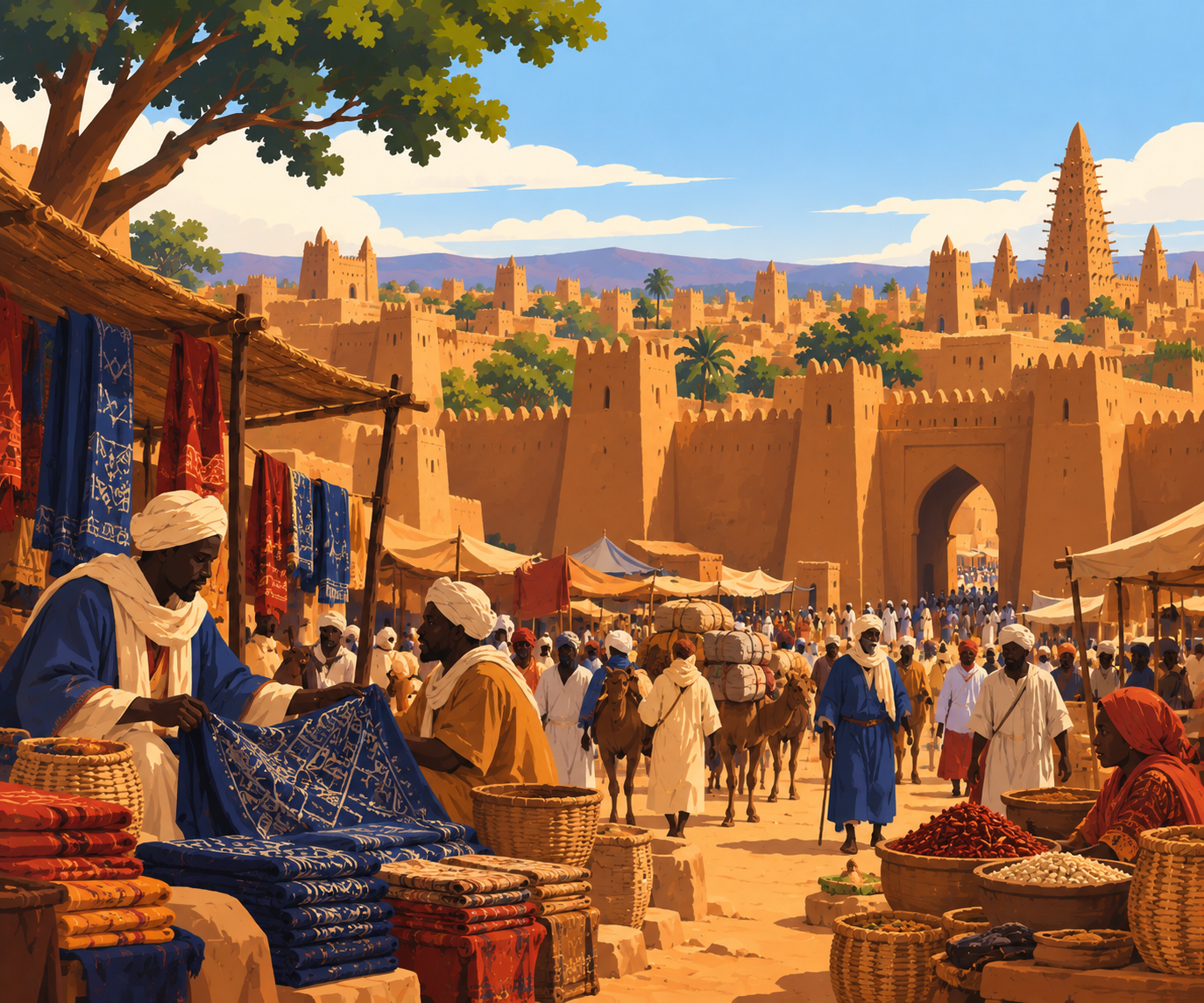
Caravans crossed the desert carrying goods, people, animals and ideas. States able to participate in and influence these networks could gain access to valuable resources and distant markets.
Kanem occupied an important position within this world.
Its economy was not based only on long-distance trade. Agriculture, livestock keeping and regional exchange remained essential. But trans-Saharan connections gave its rulers access to a much wider commercial and political system.
They also brought Kanem into sustained contact with the Islamic world.
Islam entered the court
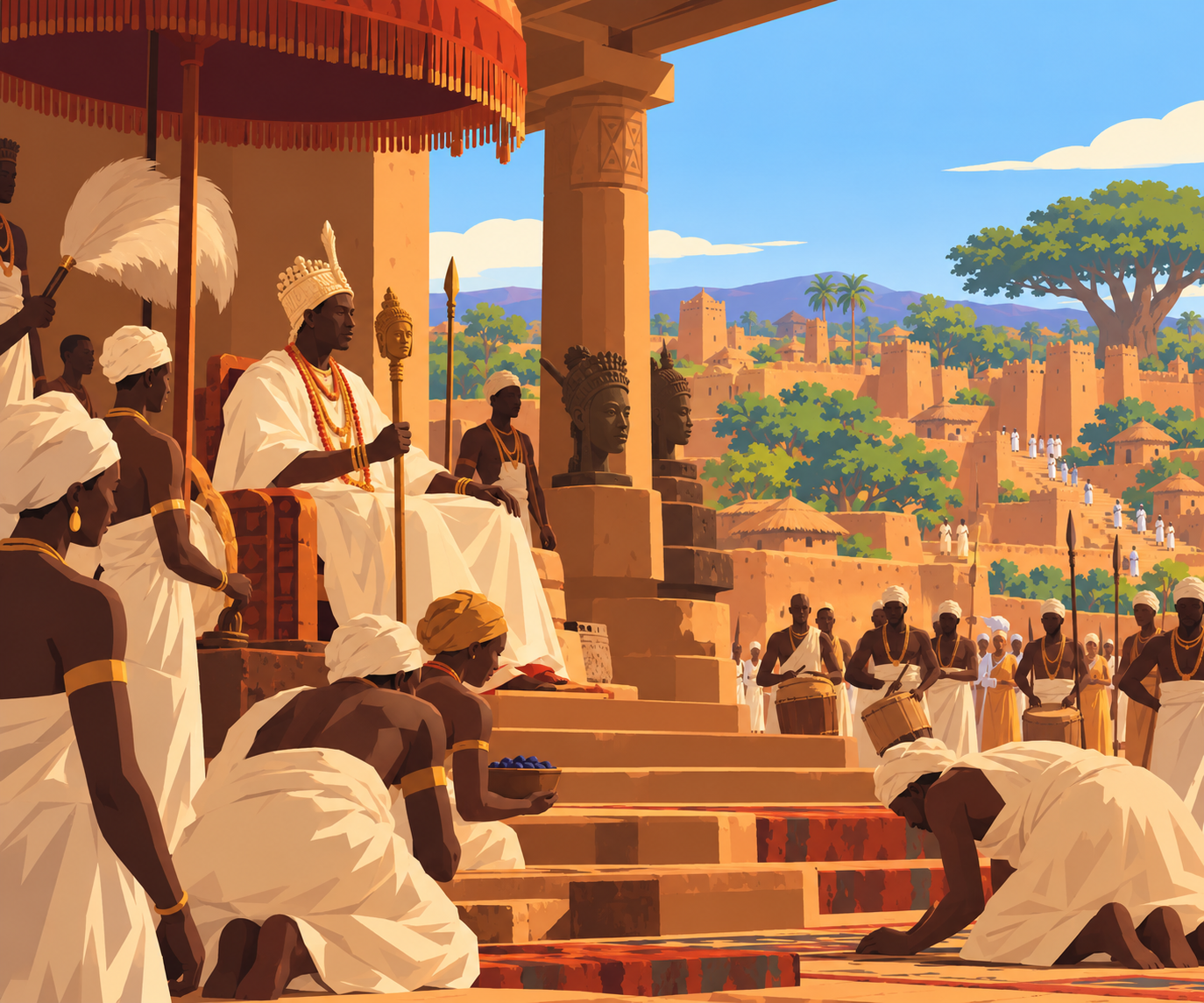
One of the most consequential changes in Kanem’s history was the adoption of Islam by its rulers.
Islam did not arrive across Africa in one movement or at one moment. Merchants, scholars, travellers and political relationships helped carry the religion across trans-Saharan networks over centuries.
By the eleventh century, Islam had become established at the Kanem royal court.
The change had consequences beyond religion.
Islam connected Kanem’s rulers to a vast intellectual, commercial and diplomatic world stretching across North Africa and beyond. Arabic literacy provided new possibilities for administration, scholarship and record-keeping.
But the conversion of rulers did not mean that everyone living within Kanem immediately became Muslim.
Older religious practices continued, and Islamisation was a gradual historical process.
This distinction matters because the religion of a royal court is not automatically the religion of an entire population.
A dynasty built lasting power
The dynasty most closely associated with the history of Kanem-Borno is usually called the Sayfawa, although the early dynastic history and traditions surrounding its origins remain subjects of historical debate.
Later traditions connected the dynasty to a legendary Arabian figure, Sayf ibn Dhi Yazan. Such genealogies were important politically, but historians do not simply treat them as straightforward records of biological ancestry. UNESCO’s General History of Africa notes the tradition while also placing Kanem’s formation within the much older population history of the Lake Chad region.
What is clearer is that the ruling dynasty became remarkably durable.
Individual rulers rose and fell. Political centres moved. Internal struggles occurred. Yet dynastic government survived across centuries.
Kanem’s rulers carried the title mai.
Among the most important was Mai Dunama Dabbalemi, whose reign in the thirteenth century is associated with a period of major expansion and stronger Islamic connections.
Under rulers of this era, Kanem became a significant power in the central Sudan—the broad historical region south of the Sahara, not the modern country called Sudan.
Lake Chad sat at the centre of different worlds
Kanem’s importance cannot be understood only through kings.
Its power depended on geography and people.
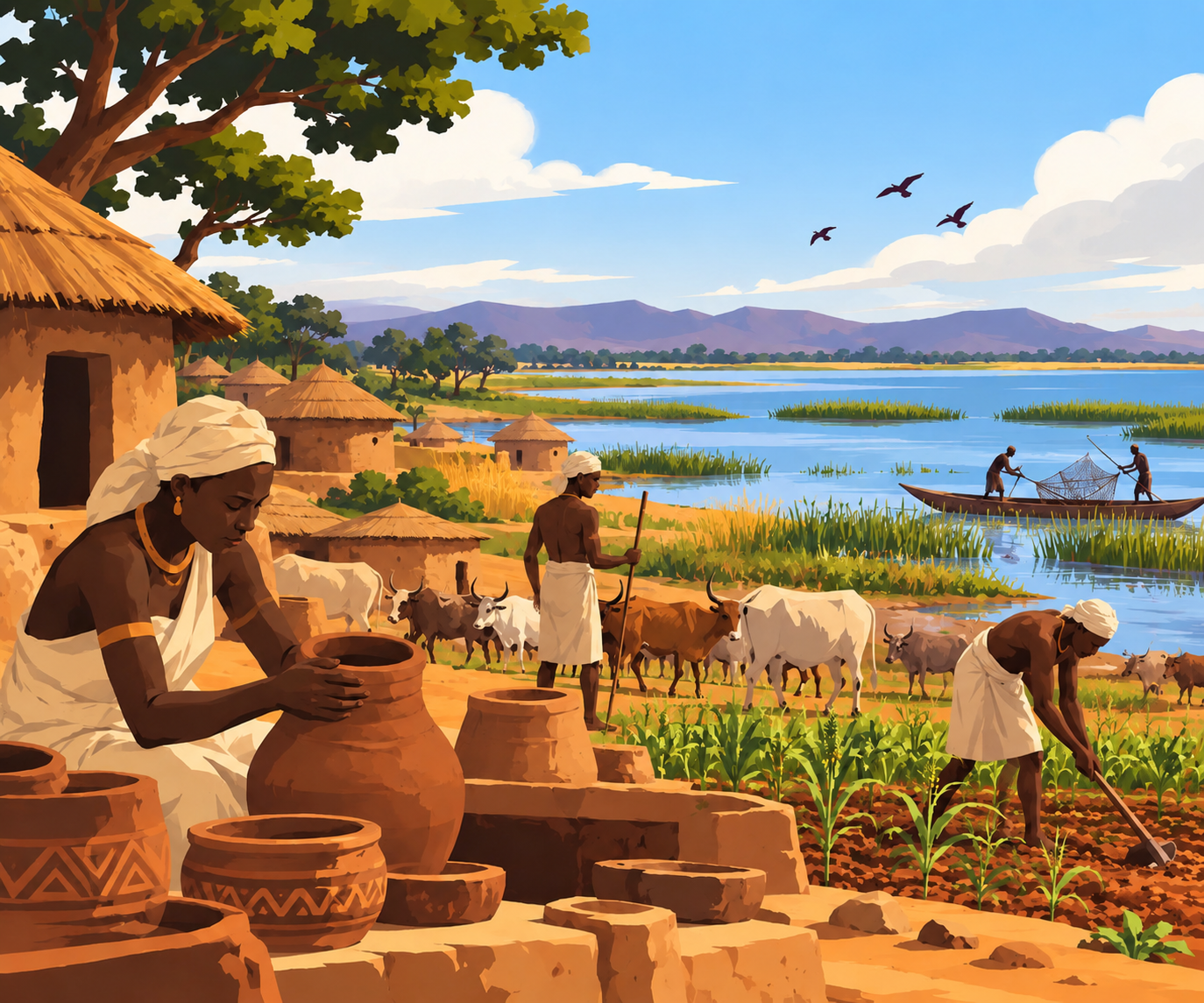
The Lake Chad Basin connected pastoral communities, farmers, fishers, craftspeople and merchants. Routes extended north across the Sahara, west towards other Sahelian societies and south into regions that are now parts of Nigeria and Cameroon.
This was the world already visible in the archaeology of Daima.
The difference is that political organisation was becoming much larger.
Earlier communities had built settlements, cultivated land and participated in exchange without necessarily belonging to a powerful centralised state.
Kanem increasingly brought territories and communities under royal authority.
The ancient Lake Chad world was becoming an imperial one.
Power did not mean permanent stability
Large states often look permanent when their history is compressed into a few paragraphs.
They were not.
Kanem experienced succession disputes, rival factions, rebellions and conflicts with neighbouring peoples. Control over territory expanded and contracted.
From around the thirteenth century onward, serious struggles increasingly affected the kingdom.
Historical sources describe prolonged conflicts involving groups collectively identified as the Bulala, while political instability weakened the Sayfawa position in Kanem.
Eventually, the dynasty lost its old centre of power east of Lake Chad.
For many kingdoms, that might have been the end of the story.
For Kanem, it became a relocation.
The rulers crossed to Borno
During the fourteenth century, the Sayfawa rulers were forced from Kanem and moved westward towards Borno, on the western side of Lake Chad.
That shift is one of the defining moments in the history of the state.
The political centre that had developed in Kanem was now being rebuilt in another part of the Lake Chad Basin.
This is why historians commonly speak of Kanem-Borno.
The name does not mean that one unchanged empire continuously occupied the same territory. It describes a connected political history in which a ruling tradition originating in Kanem eventually established its principal base in Borno.
The move also brought the dynasty more directly into the history of the territory that would eventually become northeastern Nigeria.
Borno already had people
There is an important danger in telling this story simply as a king moving his government from one location to another.
Borno was not empty.
Communities had lived south and west of Lake Chad for centuries. The archaeological record discussed in the previous chapter demonstrates exactly that.
The incoming political establishment therefore encountered existing societies.
Some were incorporated. Some resisted.
Historical sources refer repeatedly to groups called the Sao, particularly in connection with conflicts accompanying the establishment and expansion of Borno. But historians continue to debate exactly who the Sao were and how the name relates to the different archaeological populations of the Lake Chad region.
It would therefore be misleading to imagine a simple story in which one clearly defined ethnic group replaced another.
The evidence is more complicated.
Kanem did not simply become Borno overnight
Political relocation took time.
The centuries surrounding the movement from Kanem into Borno involved conflict, negotiation and consolidation. Cambridge research on the Sao notes that struggles connected with the creation of Borno stretched from roughly the thirteenth into the seventeenth century.
Archaeology also warns against making the story too neat.
Researchers studying sites associated with medieval Kanem-Borno have found that matching written traditions to specific archaeological places can be difficult. Research at Garumele in Niger, for example, has examined traditions connecting the site with Kanem-Borno while highlighting how uncertain some questions about the empire’s origins and political geography remain.
This is an important difference between history and legend.
A chronicle can give us a sequence of rulers.
Archaeology asks where people actually lived, what they built and what physical evidence remains.
Sometimes the two fit together.
Sometimes they do not.
Borno grew into a powerful state of its own
The relocation eventually succeeded.
Borno developed into a major political and commercial power west of Lake Chad, while the Sayfawa dynasty continued.
Its position connected several worlds: the central Sahara to the north, Hausa territories to the west, the Lake Chad Basin itself and societies farther south and east.
Trade remained important, but Borno’s strength also depended on agriculture, taxation, livestock and control over people and territory.
Over time, rulers strengthened the state and established important political centres.
One of the most significant would eventually be Birnin Gazargamo, which became the capital of Borno during the later fifteenth century. Archaeological and historical research treats its emergence as part of the longer development of settlement and state formation around Lake Chad.
By then, the political world that began centuries earlier in Kanem had been transformed.
But it had survived.
Its history crossed modern borders
Today, Kanem-Borno can be awkward to place inside a national history.
Its early centre was in what is now Chad.
Its rulers later established themselves in what is now northeastern Nigeria.
Its influence and relationships extended into areas that today belong to Niger and Cameroon.
But those borders did not exist.
This is one reason ancient and medieval African history cannot always be divided neatly into modern countries.
Kanem-Borno belongs to Nigerian history because Borno became one of its principal centres and because its political, religious and cultural legacy profoundly shaped northeastern Nigeria.
But it also belongs to the histories of neighbouring countries and to the wider history of the Lake Chad Basin.
Modern borders divided a historical region that had been connected for centuries.
What we know
Kanem emerged as an increasingly powerful state around the Lake Chad region by the early second millennium CE. Its rulers adopted Islam, participated in trans-Saharan networks and established a durable dynastic political tradition. By the eleventh century, Kanem and Borno were becoming major centralised powers in the Sahel.
Political conflict eventually pushed the ruling dynasty from Kanem towards Borno, where a powerful successor state developed west of Lake Chad.
The history is supported by a combination of Arabic writings, later chronicles, oral traditions and archaeology.
What we don’t know
The earliest centuries of Kanem remain difficult to reconstruct precisely.
Later traditions preserve detailed genealogies and origin stories, but they were not necessarily written at the time of the events they describe. Historians therefore compare them cautiously with external written sources and archaeological evidence.
The relationship between early Kanem-Borno and archaeological communities around Lake Chad is also complex. Archaeologists continue to investigate the development of fortified settlements and early state formation in the region.
We should therefore avoid treating every ancient community around Lake Chad as automatically “Kanuri,” “Sao” or part of Kanem-Borno.
Those identities have histories of their own.
Next: The Hausa States: How Cities Became Kingdoms
Sources
Toyin Falola and Matthew M. Heaton, A History of Nigeria, Cambridge University Press — overview of the development of early Nigerian societies and the emergence of Kanem-Borno as a major Sahelian state.
UNESCO, General History of Africa — historical treatment of the formation of Kanem, population movements around Lake Chad and the later development of Kanem-Borno.
Anne Haour and Boube Gado, “Garumele, ville médiévale du Kanem-Borno? Une contribution archéologique,” The Journal of African History — archaeological examination of medieval Kanem-Borno and the difficulties of connecting historical traditions with archaeological sites.
Dierk Lange, “Préliminaires pour une histoire des Sao,” The Journal of African History — examination of the Sao and the conflicts surrounding the emergence of Borno west and south of Lake Chad.
Graham Connah, “The Daima Sequence and the Prehistoric Chronology of the Lake Chad Region of Nigeria,” The Journal of African History — archaeological chronology showing the much older settlement history underlying the later political development of the region.