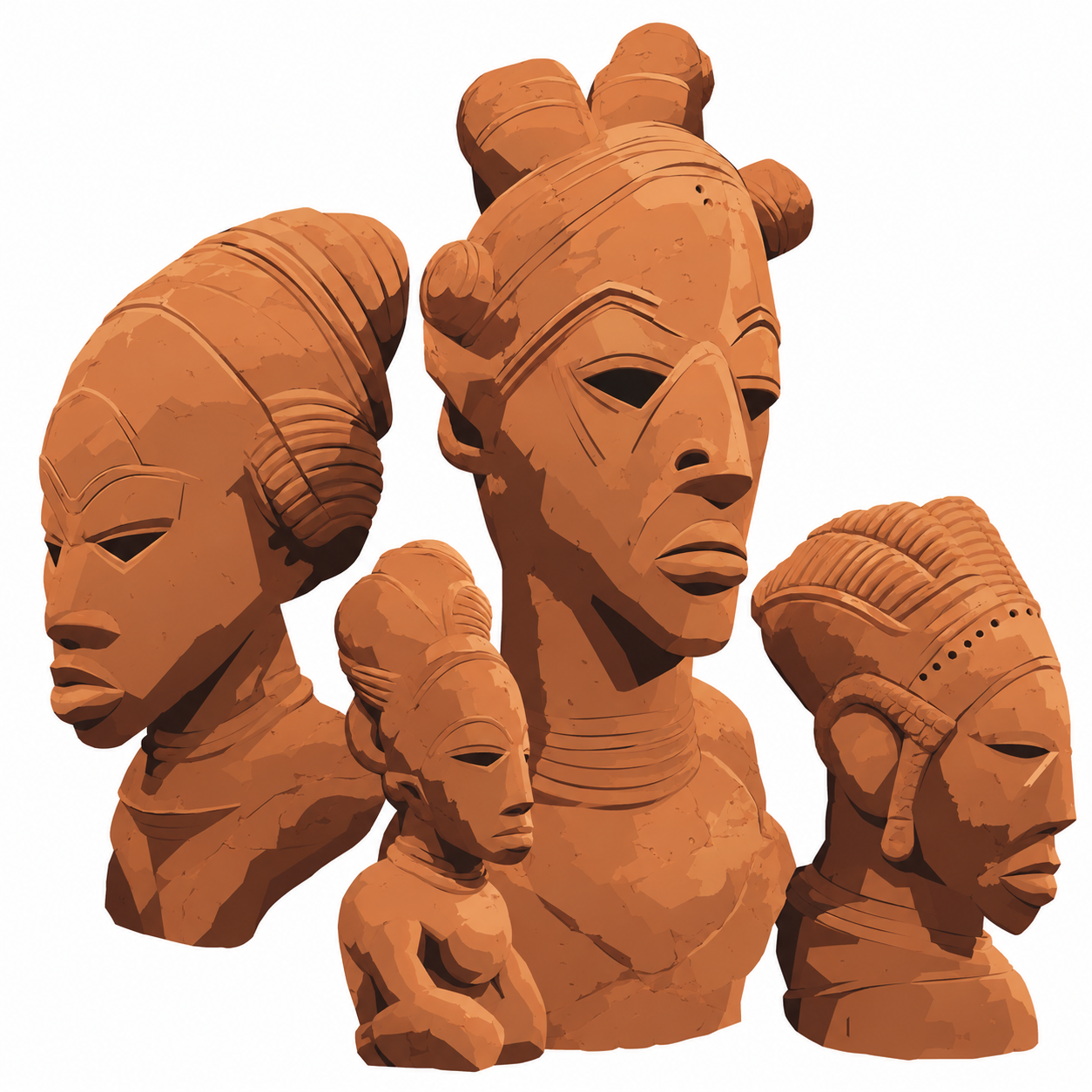
The previous chapter of Openr History introduced the Nok communities of central Nigeria, known today mainly for their remarkable terracotta sculptures. But buried alongside parts of that story is evidence of another development that would become enormously important across the region: ironworking.
Iron did not arrive as a finished object. Communities had to learn how to identify suitable raw materials and transform them into workable metal through specialised processes. Archaeological sites preserve traces of that knowledge in the form of furnaces, slag, fragments of equipment and finished iron objects.
Some of Nigeria’s most important evidence comes from central Nigeria, particularly sites associated with the Nok archaeological tradition. Other early evidence has also been found farther southeast around the Nsukka region.
Together, these discoveries reveal something larger than the arrival of a new material. They show the development of specialised technological knowledge in ancient Nigerian communities.
Before iron, people were already making sophisticated tools
Calling this period an “Iron Age” can create the impression that iron suddenly replaced stone. Archaeology presents a more complicated picture.
People had been making effective tools from stone and other materials for thousands of years before ironworking appeared. Even after communities began producing iron, older technologies did not necessarily disappear immediately.
What changed was the range of materials available.
Iron could be fashioned into cutting implements, agricultural tools and other durable objects. Over time, that created new possibilities for communities already farming, building settlements and managing the surrounding landscape.
But iron was valuable precisely because producing it was difficult. The technological achievement was not simply possessing iron. It was knowing how to make it.
Making iron required specialised knowledge
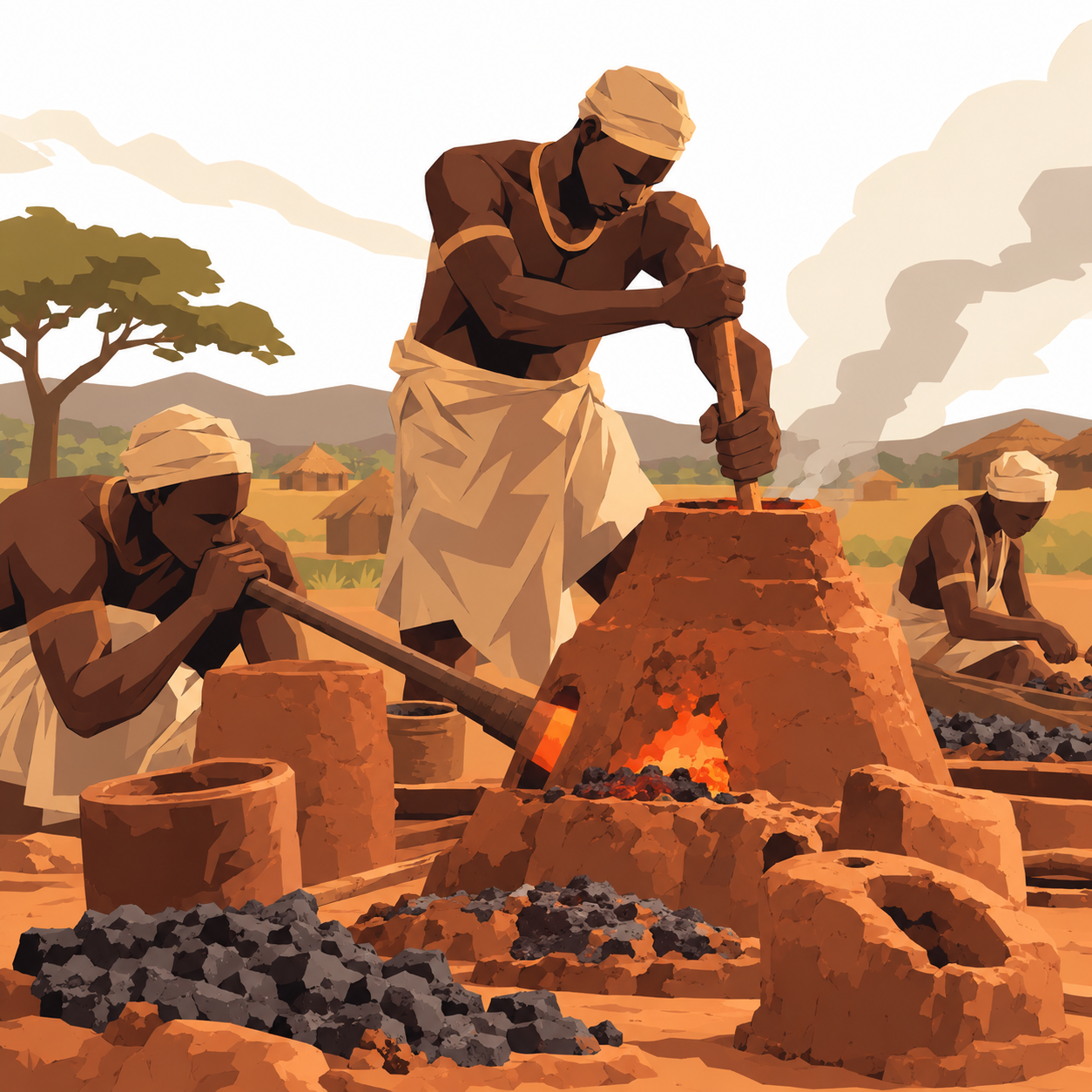
Iron does not normally emerge from the ground looking like a finished tool. Ancient metalworkers had to transform iron-bearing material through a carefully controlled process involving heat and specialised equipment.
Archaeologists studying ancient iron production therefore look for its physical remains: furnaces, slag, tuyères and other traces of metallurgical activity. Slag is the waste material produced during smelting, while tuyères are components associated with directing air into a furnace.
These remains can survive long after the people who operated the furnaces have disappeared.
That is why an ancient furnace is more than an abandoned structure. To an archaeologist, it can preserve evidence of technological knowledge: how people constructed production sites, what materials they used and how metalworking changed over time.
In central Nigeria, one site became particularly important to that story.
Taruga changed what archaeologists knew
Taruga, in central Nigeria, became one of the best-known archaeological sites associated with early Nigerian ironworking.
Excavations carried out during the twentieth century uncovered iron-smelting furnaces together with slag, pottery, iron objects and material associated with the Nok archaeological tradition. The discoveries made Taruga an important reference point in discussions about the development of iron metallurgy in West Africa.
Early excavations produced dates placing iron production there within the first millennium BCE. Later archaeological research returned to the old evidence and compared it with newly excavated Nok sites.
That newer work has made the chronology more precise.
Research published by archaeometallurgist Henrik Junius on Nok iron production found strong similarities among newly excavated central Nigerian iron-smelting sites, including their furnace designs and archaeological remains. The securely studied examples clustered mainly around the middle of the first millennium BCE.
This matters because older descriptions sometimes pushed Nok ironworking considerably further back in time.
Archaeology changes when better evidence becomes available.
Nok sculpture appears to be older than Nok ironworking
For a long time, the famous Nok terracottas and ironworking were sometimes treated as developments that appeared together.
Current research suggests otherwise.
Gabriele Franke’s recent synthesis of Nok archaeology places the widespread characteristic terracotta tradition from around 900 BCE, while the earliest presently established evidence of iron production within the Nok sequence appears at least about a century later.
That changes the story.
Ironworking did not create Nok culture. Nok communities had already developed distinctive pottery traditions, agricultural practices and elaborate figurative sculpture before the presently established evidence for iron production appears.
By the middle of the first millennium BCE, however, ironworking was firmly present at a number of Nok-associated sites. Excavated furnaces from different locations show similarities in design, dating and archaeological remains.
Iron therefore became part of an existing society rather than suddenly creating one.
Nigeria’s iron story was bigger than Nok
Central Nigeria provides some of the country’s best-known early evidence, but it is important not to turn Nok into the entire history of Nigerian ironworking.
Archaeologists have also investigated ancient iron production in southeastern Nigeria, particularly around the Nsukka region.
Sites including Opi, Lejja and Aku have produced evidence that researchers have placed within an early phase of iron metallurgy in the region. A major review of early West African metallurgy discusses dated furnace contexts from the Nsukka area extending from the first millennium BCE into the early Common Era.
More recent archaeological work continues at Lejja, a cluster of communities in present-day Enugu State with extensive remains associated with iron production. Researchers describe Lejja as an important landscape for understanding the technological and social organisation of ironworking in southeastern Nigeria, while also cautioning that many questions about the communities responsible remain unresolved.
This means Nigeria’s early iron history should not be imagined as one invention spreading neatly outward from a single place.
The archaeological picture is regional and still developing.
Iron could change everyday life
The importance of iron becomes clearer when we stop thinking only about furnaces.
Metal could become part of ordinary life.
Archaeological evidence from Nok-associated sites includes iron fragments and objects alongside pottery, grinding stones and other material connected with settlement. Older excavations at Samun Dukiya, for example, recovered iron objects alongside domestic archaeological remains.
Iron tools could support activities such as farming and woodworking, while other objects could serve specialised domestic or craft purposes.
But it would be too simple to say that iron immediately transformed every community that encountered it. Producing metal required resources, labour and specialist knowledge, and archaeological evidence does not show that every household became an iron producer.
Technology spreads unevenly.
Some communities could manufacture materials themselves. Others could obtain objects through exchange. Production could also become concentrated in particular locations or among specialists.
That raises one of the most interesting questions about ancient Nigerian metallurgy: who controlled the knowledge?
The metalworkers themselves remain difficult to see
Archaeologists can excavate a furnace.
They can analyse slag.
They can identify iron objects and date charcoal associated with production.
But reconstructing the people behind those objects is much harder.
We do not know the names of the first ironworkers at Taruga. They left no surviving written manuals explaining their techniques, and there are no contemporary accounts describing how they learned their craft.
Their knowledge instead survives indirectly through the material remains of production.
The consistency found among some Nok-associated furnaces suggests that metallurgical knowledge was being transmitted between people and across generations. Similar technological choices appearing at different sites do not happen automatically; people have to learn them.
That makes ironworking part of another kind of history: the history of knowledge.
Ironworking did not automatically create kingdoms
There is an old temptation in writing ancient history to connect technological innovation directly to political power.
Iron appears. Agriculture becomes easier. Populations grow. Armies become stronger. Kingdoms emerge.
Real history is rarely that straightforward.
The modern Nok research programme has found evidence for specialised terracotta and iron production without finding corresponding evidence for the type of centralised political hierarchy expected from a large kingdom or empire. Franke’s synthesis instead describes Nok communities as small-scale farmers living largely in dispersed homesteads.
Iron technology therefore does not prove the existence of kings, armies or central government.
A society can possess sophisticated technical knowledge without becoming an empire.
We still do not know exactly where African ironworking began
The larger question of where iron metallurgy first emerged in sub-Saharan Africa has generated decades of archaeological debate.
Different sites across Africa have produced early dates, and researchers have disagreed over the reliability and interpretation of some evidence. Older theories sometimes assumed that iron technology must have entered sub-Saharan Africa from elsewhere, while subsequent discoveries complicated attempts to construct a simple route of transmission.
Nigeria is part of that debate.
The evidence from central Nigeria securely establishes an important early ironworking tradition, but it does not by itself prove that ironworking was first invented in Nigeria or that all later West African iron metallurgy descended from Nok.
The most responsible conclusion is narrower: communities in parts of present-day Nigeria possessed established iron-smelting knowledge during the first millennium BCE.
Where the knowledge ultimately originated remains a larger archaeological question.
Ironworking continued long after Nok disappeared
The characteristic Nok archaeological tradition disappeared around the beginning of the Common Era, but ironworking did not disappear with it.
Metal production continued to develop in different parts of the region over subsequent centuries. Techniques changed, production expanded in some places, and iron became deeply embedded in the economies of many West African societies.
This is an important distinction.
Nok represents one early chapter of Nigerian metallurgy, not the entire story.
Later societies would use iron within very different political and economic worlds. Farming communities, towns and eventually powerful states all incorporated metalworking into their societies in different ways.
By then, a technology that had once been a remarkable specialised achievement had become part of a much broader technological landscape.
The furnaces tell a story the metal cannot
An iron object can travel.
It can be exchanged, carried hundreds of kilometres or inherited.
A furnace is different.
A furnace usually tells us that people were actually producing metal at that place.
That is why archaeological sites such as Taruga matter so much. The furnaces, slag and surrounding remains provide evidence not merely that ancient Nigerians possessed iron objects, but that people within these communities understood how to manufacture iron themselves.
The distinction is important.
Ancient Nigeria was not simply receiving technology from distant societies whose knowledge disappeared before reaching the people using the finished objects.
At least by the first millennium BCE, communities within the region had become metal producers.
And once that knowledge existed, it could be taught, adapted and carried forward.
What we know
Archaeological evidence establishes iron production in parts of present-day Nigeria during the first millennium BCE. Nok-associated sites in central Nigeria preserve furnaces, slag and other evidence of iron smelting, with modern research placing securely established Nok iron production after the emergence of its characteristic terracotta tradition.
Evidence from southeastern Nigeria also shows an important early metallurgical tradition around the Nsukka region. Together, these sites demonstrate that ironworking became established in more than one part of the territory that would eventually become Nigeria.
What we don’t know
We do not know the names or identities of Nigeria’s earliest ironworkers, exactly how metallurgical knowledge moved between communities, or whether different early Nigerian traditions developed independently or through connections with other populations.
The wider question of where iron metallurgy first developed in Africa also remains debated. Archaeological dates must therefore be interpreted carefully rather than used to declare one society the unquestioned inventor of African ironworking.
Sourcess
Gabriele Franke, “The Archaeology of Nok Culture in Nigeria (2nd/1st Millennium BCE)”, Oxford Research Encyclopedia of African History — modern synthesis of Nok chronology and the relationship between terracotta production and ironworking.
Henrik Junius, “Nok Early Iron Production in Central Nigeria — New Finds and Features,” Journal of African Archaeology — archaeological analysis of Nok iron-smelting sites, furnace designs and chronology.
Recent archaeological research on Lejja, published in npj Heritage Science — discussion of the iron-producing landscape and archaeological questions surrounding metallurgy in southeastern Nigeria.
Research on early West African metallurgy — comparative archaeological evidence concerning early iron-smelting sites in Nigeria and elsewhere in West Africa.