The figures were disclosed in the World Bank’s October 2026 Nigeria Development Update, which examined how Nigeria’s recent economic reforms are affecting government finances and household welfare.
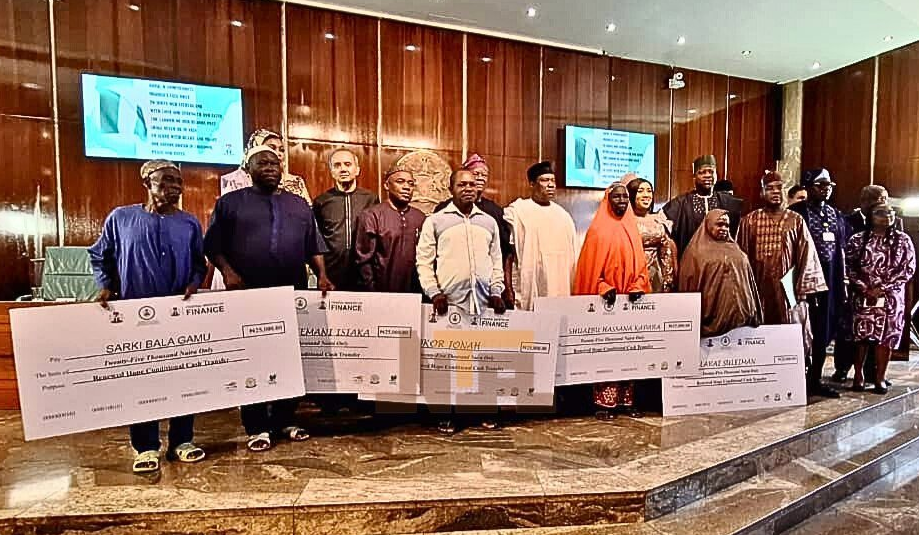
According to the report, the government reported distributing ₦658.9 billion in direct cash transfers to 10.46 million poor and vulnerable households by September 2026.
The World Bank acknowledged the expansion but called for more reliable funding, wider coverage and payments sufficient to provide meaningful relief.
Why did Nigeria introduce the cash transfer programme?
In May 2023, President Bola Tinubu removed Nigeria’s petrol subsidy. The government subsequently introduced foreign exchange reforms that contributed to significant increases in the naira prices of imported goods.
These changes were intended to improve public finances and address longstanding economic problems, but they also increased living costs.
To reduce the immediate burden on poorer households, the government announced a temporary cash transfer programme.
Under its original design, 15 million households were expected to receive ₦75,000 each, divided into three monthly payments of ₦25,000.
The initiative was supported through the World Bank-financed National Social Safety Net Programme Scale-Up, which also aimed to strengthen the government’s system for identifying vulnerable households and delivering payments.
How much has each household received?
The government’s reported ₦658.9 billion expenditure divided by 10.46 million households works out to approximately ₦63,000 per household.
However, that calculation does not establish how much each household actually received.
The figures do not provide a complete breakdown showing which beneficiaries received one payment, multiple payments or their entire entitlement.
The World Bank says the programme uses biometric and digital verification systems to identify recipients and deliver funds.
Against the original target of 15 million households, the reported 10.46 million represents roughly 70% coverage. But this comparison alone cannot establish how many eligible households remain unpaid.
A fuller assessment would require independently verifiable payment records, disbursement dates and information on unsuccessful transactions.
Why does the World Bank say more needs to be done?
The concern is that temporary assistance, even when successfully delivered, cannot provide lasting protection against poverty without a reliable support system.
The World Bank identifies three important weaknesses: coverage, adequacy and continuity.
Coverage concerns how many vulnerable households receive assistance. Adequacy asks whether the money is enough to meet essential needs. Continuity concerns whether payments arrive regularly enough for households to plan around them.
These concerns are particularly important because Nigeria’s poverty problem remains substantial.
In its October 2026 Poverty and Equity Brief, the World Bank estimated that 63% of Nigerians were living below the national poverty line in 2026.
This is a projection rather than a new nationwide household survey, but it illustrates the scale of the challenge.
Do cash transfers actually reduce poverty?
Research suggests that well-designed transfers can improve household welfare.
A 2025 World Bank study examining earlier transfers to women in northern Nigeria found improvements in household consumption and economic activity.
Business creation among recipients initially increased by 12 percentage points, while some economic benefits extended to households that did not receive payments.
Other Nigerian research has linked cash transfers to improved food security and dietary diversity.
However, those studies examined different programmes. Their findings cannot automatically be used to claim that the current ₦658.9 billion intervention has produced identical results.
Can Nigeria afford a permanent support system?
The World Bank argues that cash assistance should gradually become a predictable public programme, supported by dedicated federal and state budgets rather than primarily emergency interventions.
Its October report found that Nigerian states experienced substantial revenue growth between 2023 and 2025.
Although states increased spending on social protection, the Bank says better budgeting, accountability and public-service delivery are necessary to translate higher government revenues into improved living conditions.
What this means
For families struggling with food, school and healthcare expenses, cash assistance can provide immediate relief.
But Nigerians also need to know who qualifies, how recipients are selected, when payments will arrive and whether outstanding payments can be challenged.
The success of Nigeria’s cash transfer programme should ultimately be measured not only by how much money the government distributes, but by whether that assistance reliably reaches vulnerable households and improves their living conditions.