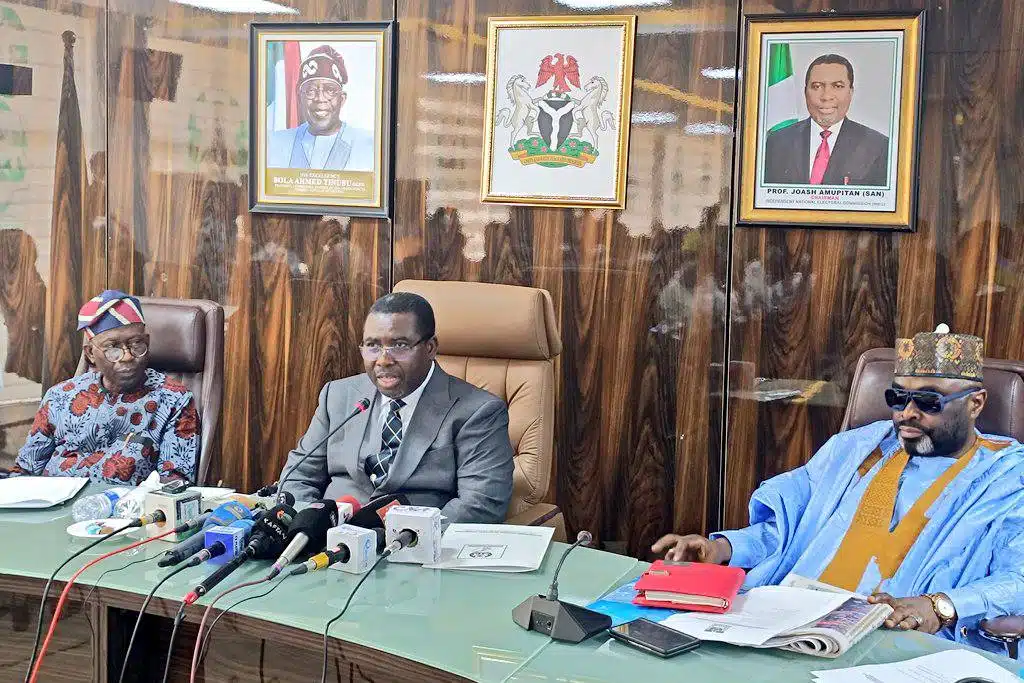
INEC Chairman Joash Amupitan disclosed the development at the commission’s World Press Conference and National Stakeholders’ Meeting in Abuja on October 6.
He said the new AI (Artificial Intelligence) division sits within INEC’s ICT (Information and Communication Technology) department, while automated auditing tools have been integrated into the commission’s result-verification process. The system will operate under mandatory human oversight rather than allowing AI to make final electoral decisions.
What exactly will the AI do?
INEC says the technology will help officials detect anomalies in election records and identify possible discrepancies that require further examination.
The commission is also developing AI-driven tools to monitor its systems for suspicious activity, including possible cyber intrusions or unauthorised changes to electoral information.
That means the technology is being positioned as an auditing and warning system, rather than a machine that determines who won an election.
Amupitan said the commission is working under a five-pillar AI governance framework and is still finalising a broader policy governing how the technology will be used.
INEC is also worried about AI being used against elections
The commission is adopting AI at the same time that it is warning about the risks the technology creates.
Amupitan has previously warned that generative AI can now produce convincing fake videos, cloned voices, fabricated result sheets and false official documents that could spread rapidly during an election.
INEC says part of the new system will therefore focus on detecting disinformation and protecting the commission’s digital infrastructure.
The commission is also upgrading its wider election technology. It has procured 57,000 additional BVAS machines and says existing devices have undergone software hardening, battery optimisation and biometric calibration ahead of the election.
The important question is how AI enters the result process
This is where the announcement deserves closer attention.
Nigeria’s recent elections have already placed significant responsibility on technology through BVAS (Bimodal Voter Accreditation System) and IReV (INEC Result Viewing Portal).
Adding AI creates another technological layer inside a process where public confidence depends heavily on people understanding what the system does, what it cannot do and who remains responsible when something goes wrong.
INEC says humans will remain in control of decisions. That safeguard matters.
But the commission has not yet published enough technical detail for the public to independently understand what models are being used, what information they analyse, what counts as an “anomaly,” or how an AI-generated warning will be reviewed.
This is my argument
Using AI to flag unusual election data could be useful. The bigger risk would be asking Nigerians to trust a system they cannot understand.
Election auditing is actually a reasonable use for AI.
A computer can examine very large sets of election records much faster than a person and flag unusual patterns for officials to investigate. Used properly, that could help INEC find errors or suspicious changes earlier.
But elections are different from ordinary technology products.
A false alert, unexplained decision or poorly understood automated process can quickly become politically contested.
That is why INEC’s promise of human oversight is only one part of what is needed.
The commission should also make the system understandable enough that political parties, observers, technical experts and citizens can see where AI begins and ends in the result-verification process.
Transparency will matter particularly because INEC itself has identified public trust as central to electoral credibility.
So the strongest case for the technology is straightforward: AI can help humans find problems faster.
The strongest concern is equally straightforward: if the process becomes less transparent because AI is involved, the technology intended to strengthen confidence could instead create another source of suspicion.
For 2027, the real test will therefore not be whether INEC can say it used artificial intelligence.
It will be whether Nigerians can clearly understand what the AI checked, what it found, and which human official remained responsible for the final decision.