The Federal Government’s recent disagreement with the World Bank over Nigeria’s debt payments exposes a problem larger than the figures themselves: the public still lacks timely access to the government’s own financial performance reports.
In its October 2026 Nigeria Development Update, the World Bank reported that Nigeria spent ₦7.7 trillion on interest payments during the first half of 2026, against federal revenue of approximately ₦6.2 trillion.
These figures produce an interest-to-revenue ratio of about 124%, meaning reported interest payments exceeded the revenue figure used in the comparison.
The Federal Ministry of Finance disputed that interpretation, arguing that the calculation did not accurately reflect Nigeria’s fiscal position.
Disagreement over economic statistics is not unusual. Governments and international institutions frequently use different accounting methods, reporting periods and financial assumptions.
What makes Nigeria’s situation particularly concerning is that the government is challenging an external assessment while its own quarterly budget implementation reports for 2026 remain unavailable in the public archive.
The issue is not whether Nigerians should believe the government or the World Bank. It is why they cannot independently examine sufficiently current official records and reach informed conclusions themselves.
The reports that should have settled the argument
Nigeria already has a legal framework for financial disclosure.
Section 30 of the Fiscal Responsibility Act, 2007 requires the Minister of Finance, through the Budget Office of the Federation, to monitor budget implementation and report quarterly.
The law also requires publication of these reports within 30 days after the end of each quarter.
These are not merely administrative documents. They show how much revenue the government actually received, how much it borrowed, what it spent on debt obligations and how closely expenditure followed the approved budget.
For example, the National Assembly may approve billions of naira for hospitals, schools or road construction. But an appropriation only establishes spending authority; it does not prove that money was released or projects completed.
Budget implementation reports help reveal the difference.
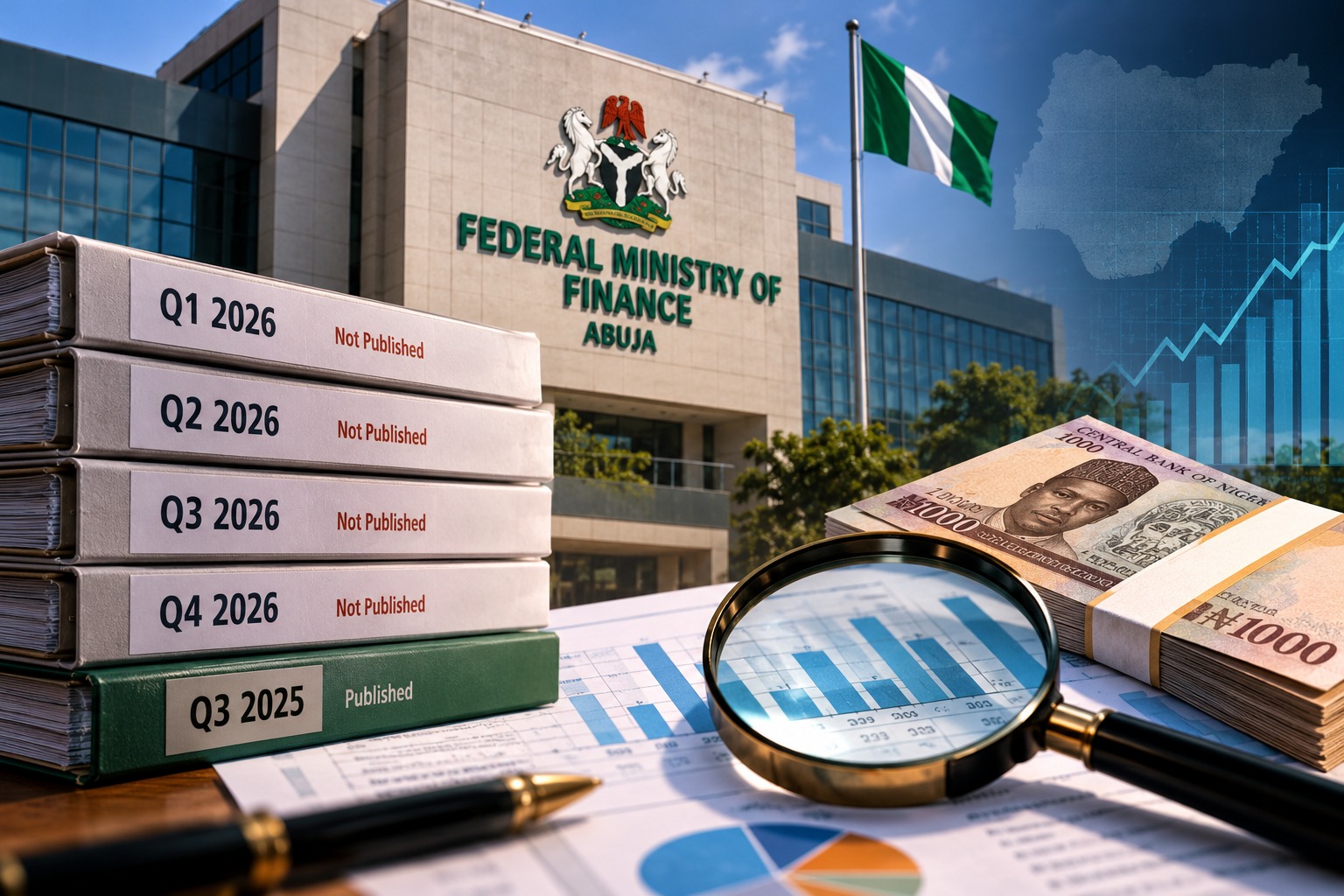
As of October 20, 2026, the Budget Office’s public quarterly archive still lists no quarterly implementation reports for 2026.
Its latest available report covers the third quarter of 2025 and was published on August 24, 2026, nearly eleven months after the quarter ended.
The fourth-quarter 2025 report is also absent from the listed quarterly records.
That leaves Nigerians without the most current official information needed to independently assess the government’s claims about its financial performance.
The government has an explanation, but it is not enough
It would be unfair to suggest that the Budget Office has offered no explanation.
In a May 17, 2026 statement, its Director-General, Tanimu Yakubu, explained that extensions to the 2025 budget had complicated the reporting process.
According to him, the government needed additional time to reconcile revenue collections, expenditure, borrowing and other financial records following changes to the budget’s implementation period.
This is a legitimate administrative concern.
Nigeria has repeatedly operated overlapping budgets, with capital projects from one financial year continuing into another. Reconciling such expenditure can become complicated, particularly when different government institutions maintain separate financial records.
Inaccurate reports can mislead policymakers and citizens. Publishing reliable information therefore matters as much as publishing it quickly.
But this explanation has limits.
A government’s responsibility to publish accurate financial information does not disappear because the accounting process is difficult.
The Budget Office promised in May that outstanding reports would be released in phases over the following weeks.
Five months later, substantial reporting gaps remain.
Although extending the legal period for implementing a budget may be justified, it does not automatically establish that quarterly public disclosure obligations have been suspended. That legal distinction deserves a clear explanation from the government.
If comprehensive reconciliation requires additional time, authorities could publish provisional figures with appropriate qualifications, followed by reconciled accounts and explanations of significant revisions.
Providing imperfect but clearly labelled preliminary information may be more useful than leaving the public without any contemporary account of spending.
The debt dispute shows exactly why transparency matters
The Finance Ministry’s objection to the World Bank’s debt figures deserves serious examination.
In its October 18 response, the ministry argued that the reported interest payments included obligations serviced by the Federal Government on behalf of state governments.
It also maintained that the revenue figure excluded income generated by some government agencies and enterprises but not yet remitted to the Treasury.
Furthermore, the government argued that revenue collections are uneven throughout the year and that assessing annual debt sustainability using only six months of figures could produce a misleading conclusion.
These are reasonable issues to raise.
An interest-to-revenue ratio can change substantially depending on whether the calculation uses federal or consolidated government revenue, cash received or accrued income, and interest alone or total debt repayments.
The ministry also cited improvements in revenue growth and debt-service indicators as evidence that the government’s reforms were strengthening public finances.
But this is precisely where independent verification becomes necessary.
If the ministry believes the World Bank’s figures exclude relevant revenue, the most persuasive response would be to publish the complete reconciled accounts, identify the additional income and show how the government’s preferred calculation was derived.
It should also explain which debt obligations belong to the Federal Government and which are being serviced on behalf of other tiers of government.
A public disagreement should lead to better information, not competing statements that citizens cannot adequately assess.
The World Bank’s figures are not beyond criticism, and neither are the government’s. Both should be examined using transparent and comparable financial records.
Economic reforms require public accountability
Since 2023, Nigerians have experienced major economic policy changes, including the removal of petrol subsidies, exchange-rate reforms and subsequent adjustments to taxes and public finances.
The government argues that these decisions are necessary to restore stability, improve revenue and create conditions for sustainable economic growth.
There is evidence that some macroeconomic indicators have improved, and the World Bank’s October 2026 update acknowledges progress in economic resilience.
However, improved headline figures do not automatically establish that public resources are being used effectively.
Nigeria’s economic recovery must also be evaluated through the quality of public spending.
If revenue collections are increasing, how much additional funding is reaching health facilities? Are education allocations being released? How much of the capital budget is being implemented? What proportion of government income is committed to interest payments?
These questions cannot be answered adequately through budget announcements or political statements.
They require regularly published, verifiable financial information.
The World Bank’s October report itself emphasises that Nigeria must translate improved public revenues into better services, stronger institutions and meaningful improvements in living standards.
That transformation requires scrutiny of actual expenditure, not simply promises of future benefits.
Transparency must become part of the reform itself
The government does not need to prove that every reform has succeeded. Economic policies can produce mixed results, especially in a country facing Nigeria’s structural challenges.
What it must demonstrate is a willingness to measure those results openly, explain setbacks and subject its claims to independent examination.
The immediate solution is straightforward.
The Budget Office should publish all outstanding quarterly implementation reports, provide a clear timetable for subsequent releases and explain any differences between preliminary and final accounts.
The Ministry of Finance should also make the calculations supporting its debt-sustainability claims publicly accessible, including the revenue and debt categories used.
Meanwhile, the National Assembly and Fiscal Responsibility Commission should strengthen oversight of statutory reporting obligations, ensuring that publication deadlines are treated as meaningful requirements rather than optional administrative targets.
None of these measures would guarantee successful economic reforms.
But they would make it easier to distinguish progress from projections, genuine financial improvements from accounting differences, and unavoidable delays from failures of accountability.
For Nigerians who have been asked to endure difficult economic adjustments in expectation of a better future, that distinction matters.
Public trust cannot depend entirely on the government’s assurance that its policies are working. It must be supported by evidence that citizens can independently examine.
The government has every right to challenge the World Bank’s assessment of Nigeria’s finances. But if it wants its own figures to command greater confidence, it must first make the underlying records available.
Transparency is not something to introduce after reforms succeed. It is one of the conditions by which their success should be judged.