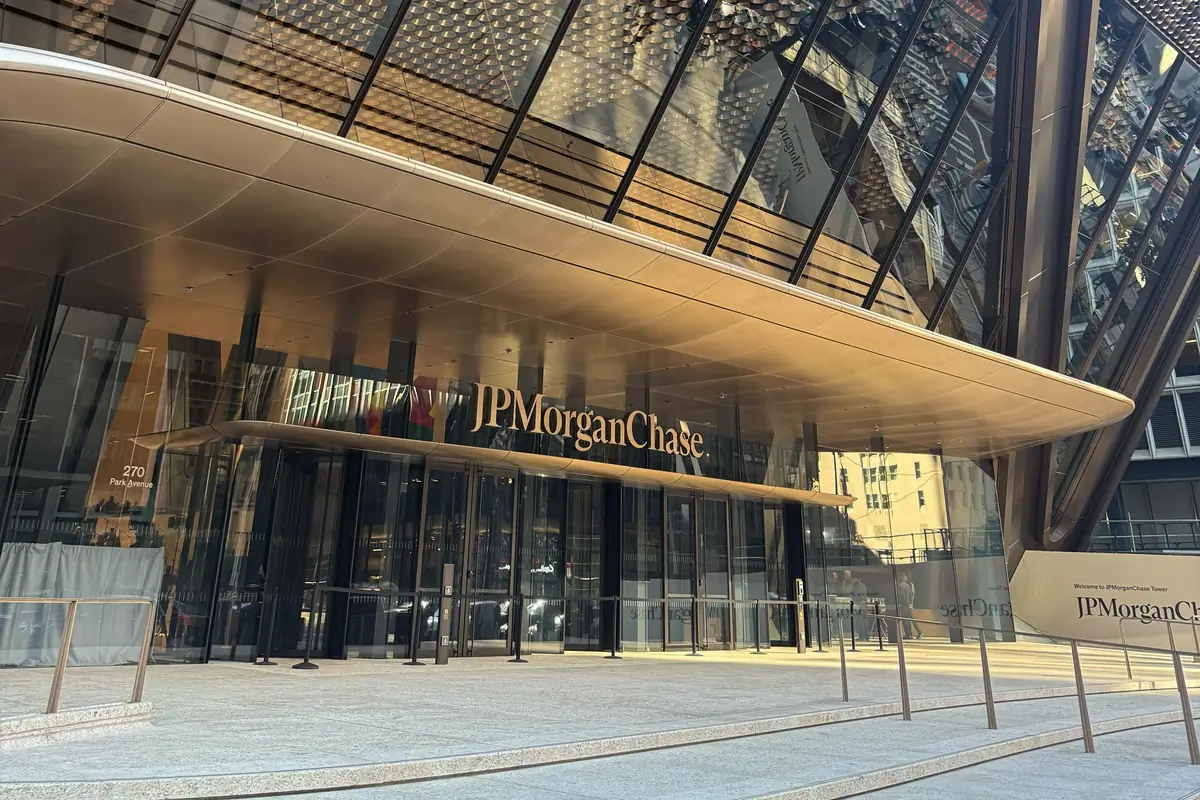
JPMorgan Chase & Co., the largest bank in the United States by assets, has reportedly deposited ₦50 billion, approximately $38 million, with the CBN (Central Bank of Nigeria) as part of its application for a Nigerian merchant banking licence.
According to a Bloomberg report published on Tuesday, October 20, the deposit satisfies one of the final financial requirements in the bank’s licensing process.
The information came from people familiar with the application who requested anonymity because the regulatory process remains private.
JPMorgan expects to secure approval before the end of 2026 or in early 2027, subject to the CBN’s decision. Neither institution had publicly confirmed the anticipated approval date.
The development follows an announcement by Dapo Olagunju, JPMorgan’s Managing Director for West Africa, during the Nigeria–Asia Financial Connectivity Dialogue held in Singapore on October 8.
At the meeting, organised by the CBN alongside JPMorgan, Nigerian Exchange Group and FMDQ Group, Olagunju disclosed plans to establish a merchant bank in Nigeria before the end of the year, subject to regulatory approval.
Why JPMorgan deposited ₦50 billion
The deposit corresponds to Nigeria’s minimum capital requirement for a nationally licensed merchant bank.
In March 2024, the CBN introduced new capital requirements to strengthen the country’s financial institutions and improve their ability to support economic growth.
Under the official recapitalisation framework, merchant banks must maintain at least ₦50 billion in qualifying paid-up capital.
Commercial banks with national authorisation require ₦200 billion, while those with international authorisation require ₦500 billion.
The requirements were designed to ensure that banks have sufficient financial resources to withstand economic shocks and finance larger transactions.
JPMorgan’s reported deposit matches the merchant banking threshold, but meeting a capital requirement does not automatically grant permission to operate.
The CBN must still complete its licensing assessment before the proposed bank can begin operations.
What is a merchant bank, and how would it operate?
Unlike commercial banks such as Access Bank, Zenith Bank or FirstBank, which provide everyday banking services to individuals and businesses, merchant banks primarily serve corporations, institutions and large investors.
Their activities typically include corporate lending, investment advisory services, financing major projects, managing securities transactions and facilitating international trade.
Under the CBN’s merchant banking regulations, these institutions cannot engage in ordinary retail banking or provide retail loans.
A Nigerian merchant banking licence would therefore allow JPMorgan to participate more directly in financing large companies, arranging investments and supporting international transactions.
For example, a Nigerian manufacturing company seeking substantial financing to expand its factory could potentially obtain funding through a licensed merchant bank.
Similarly, businesses involved in importing industrial equipment or developing infrastructure may benefit from additional access to international financing arrangements.
However, the availability and cost of such financing would depend on JPMorgan’s eventual operating strategy and lending requirements.
JPMorgan is not entering Nigeria for the first time
Although the proposed licence represents an expansion, JPMorgan already has a longstanding relationship with Nigeria.
According to the bank’s official Nigerian profile, its predecessor, Chase Manhattan Bank, established a presence in Lagos in 1961 and opened a representative office in 1982.
Over subsequent decades, JPMorgan has participated in financing arrangements involving Nigerian companies and government institutions.
Its operations have included advisory services, international debt transactions and investment banking activities.
The proposed merchant bank would represent a shift from its existing representative-office structure towards a locally licensed institution with broader operating powers.
This distinction matters because establishing a licensed Nigerian bank would allow the institution to undertake regulated activities locally, rather than serving clients primarily through its international banking network.
What could its expansion mean for Nigeria’s economy?
JPMorgan’s proposed expansion comes as Nigeria seeks to attract international investment, deepen its financial markets and improve access to capital.
Additional merchant banking capacity could increase competition for large corporate financing transactions, potentially providing Nigerian businesses with more options when raising funds.
It could also strengthen connections between Nigerian companies and foreign investors seeking opportunities in sectors such as energy, infrastructure, telecommunications and manufacturing.
However, the development should not be mistaken for an immediate injection of ₦50 billion into Nigerian businesses.
The reported ₦50 billion is part of a regulatory capital arrangement, not an announced lending programme or investment fund.
Any future financing benefits would depend on the bank receiving approval, commencing operations and successfully attracting clients.
Foreign-currency lending also carries risks. Companies earning mainly in naira could face greater repayment costs if the currency weakens against the dollar.
What this means for Nigerians
For ordinary bank customers, JPMorgan’s planned merchant bank is unlikely to immediately change access to savings accounts, personal loans or everyday payment services.
Its more direct effects would be felt by larger companies, institutional investors and businesses seeking substantial financing.
Over time, successful investments could support business expansion, infrastructure development and employment, although none of these outcomes is guaranteed by the licence application.
The most important next development will be the CBN’s final decision.
JPMorgan’s reported commitment signals interest in Nigeria’s financial market, but the real economic impact will depend on what the bank does after obtaining approval, not simply the amount it has deposited.