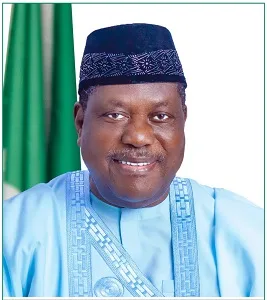
Before becoming SGF, Akume served as Governor of Benue State from 1999 to 2007, represented Benue North-West in the Senate from 2007 to 2019, and served as Minister of Special Duties and Inter-Governmental Affairs from 2019 to 2023
In office since Verified
By Openr Editorial7 min read
George Akume
Secretary to the Government of the Federation
Responsibilities of the office
Coordinating ministries and government agencies
The office monitors Ministries, Departments and Agencies (MDAs), particularly their implementation of Federal Government policies, programmes and decisions.
Supporting the Federal Executive Council
The SGF's office serves as the secretariat for the Federal Executive Council (FEC), the National Council of State, and other constitutional councils chaired by the President or Vice President. This includes processing council documents and keeping records of government decisions.
Advising the Presidency
The OSGF describes itself as a frontline advisory institution to the Presidency and participates in policy formulation, coordination, harmonisation and implementation.
Following up presidential and cabinet decisions
Once major decisions are taken, the office helps communicate them to the relevant institutions and monitors follow-up action and implementation.
Coordinating government appointments
The office processes appointments to the leadership of statutory bodies, commissions and agencies.
Handling political and constitutional matters
Constitutional, political and economic matters referred to the Presidency may be processed through the SGF's office.
Coordinating some national security and public-safety matters
The OSGF has responsibilities relating to the coordination of national security and public-safety issues, working alongside the institutions directly responsible for those areas.
Government protocol and political office holders
It deals with certain protocol matters and conditions of service for political office holders and provides administrative support for political appointees.
National honours and presidential matters
The office processes matters involving National Honours, petitions and appeals to the President, and matters concerning the presidential prerogative of mercy.
Federal-state coordination
The SGF's office liaises with Secretaries to State Governments (SSGs), helping provide an administrative link between the Federal Government and state governments.
About George Akume
George Akume is a Nigerian public administrator and politician whose career has moved through the civil service, state government, the National Assembly, the federal cabinet and, since 2023, the Office of the Secretary to the Government of the Federation. As of October 2026, he remains Nigeria’s Secretary to the Government of the Federation (SGF). OSGF
Early life
George Akume was born on 27 December 1953 in Wannune, in what is now Tarka Local Government Area of Benue State. NDNB.ng
He began his education at Native Authority Primary School, Wannune, which he attended from 1960 to 1966. He subsequently attended Government Secondary School, Otobi, now associated with Model Science School, Otukpo, from 1967 to 1971. He later studied at St. Louis College for his Advanced Level education.
Akume proceeded to the University of Ibadan, where he earned a Bachelor of Science degree in Sociology in 1978. He returned to the same university and obtained a Master's degree in Industrial and Labour Relations in 1986. In 1988, he also obtained a Certificate in Management from the Administrative Staff College of Nigeria (ASCON).
NYSC and entry into the civil service
After university, Akume completed the National Youth Service Corps (NYSC) programme in 1978–1979. Biographical records state that he taught at the then Advanced Teachers' College in Akwanga during his service year.
He subsequently joined the Benue State Civil Service, initially working as a Land Officer in the Ministry of Lands and Survey. His career then moved increasingly towards government administration.
Over the following years, he held positions including assignments in the Governor's Office, the Ministry of Education and local government administration. Archival biographical records list roles such as assistant secretary for research and policy analysis in the Governor's Office, senior assistant secretary in the Ministry of Education, under-secretary at Government House, secretary of Gboko Local Government and a period as sole administrator of Idah Local Government. He eventually rose to the rank of
This meant that Akume had spent roughly two decades in public administration before becoming an elected politician.
Governor of Benue State
Akume entered elective politics during Nigeria's transition from military rule to civilian government.
He was elected Governor of Benue State in 1999, taking office on 29 May 1999 at the beginning of Nigeria's Fourth Republic. He subsequently won a second term and served until 29 May 2007, completing eight years as governor.
His governorship therefore coincided with the first eight years of Nigeria's present democratic era.
At that stage of his political career, Akume was associated with the Peoples Democratic Party (PDP), which was also the dominant national party during the administrations of President Olusegun Obasanjo.
Twelve years in the Nigerian Senate
After completing his second term as governor, Akume moved directly into federal legislative politics.
In 2007, he was elected to the Nigerian Senate to represent Benue North-West Senatorial District. He remained in the Senate for 12 years, from 2007 to 2019.
His political affiliations changed during this period. After his earlier years in the PDP, he joined the Action Congress of Nigeria (ACN) and contested the 2011 Senate election on its platform.
In that election, Akume won 261,726 votes, according to the official biography maintained by the Office of the Secretary to the Government of the Federation, defeating PDP candidate Terngu Tsegba, who received 143,354 votes.
Senate Minority Leader
Akume became Senate Minority Leader in June 2011, holding that leadership position until 2015.
The position placed him among the principal officers of the Senate and made him one of the leading opposition figures in the National Assembly during the administration of President Goodluck Jonathan.
During his Senate career, Akume also served as Chairman of the Senate Committee on Army and was described by the OSGF as a ranking member of the Senate.
From ACN to APC
In the political realignment that preceded the 2015 general election, the ACN and several other political groups merged to form the All Progressives Congress (APC).
Akume became an APC politician and was re-elected to the Senate under the party's platform in 2015.
He sought another Senate term in 2019 but was defeated by Emmanuel Yisa Orker-Jev of the PDP, bringing his 12-year Senate tenure to an end. OSGF
Minister under President Muhammadu Buhari
Akume's departure from the Senate did not end his federal political career.
On 23 July 2019, President Muhammadu Buhari nominated him as one of his ministers. The Senate's official order paper for 24 July 2019 lists Sen. George Akume — Benue among Buhari's ministerial nominees. NASS
After confirmation, Akume became Minister of Special Duties and Inter-Governmental Affairs.
He held the position from 2019 until the end of Buhari's administration in May 2023. OSGF
The role gave Akume another level of experience within the federal executive after his previous careers in the state civil service, state executive government and federal legislature.
Secretary to the Government of the Federation
Following the inauguration of President Bola Ahmed Tinubu on 29 May 2023, Akume was selected for one of the administration's most senior coordinating positions.
President Tinubu announced Akume's appointment as Secretary to the Government of the Federation on 2 June 2023. He formally assumed office and received the handover documents from his predecessor, Boss Mustapha, on 7 June 2023. OSGF
He became the 21st Secretary to the Government of the Federation. OSGF
As SGF, Akume sits at the centre of federal government coordination. The OSGF's institutional mandate includes monitoring and coordinating implementation of government policies and programmes, advising the Presidency, coordinating policy implementation and monitoring institutions of government. OSGF
The position also places his office at the heart of Cabinet affairs and communication between the Presidency, ministries, departments and agencies.
As of October 2026, the official OSGF website continues to identify Akume as the serving Secretary to the Government of the Federation. OSGF
His career in perspective
Akume's public career can therefore be divided into five broad phases:
Period
Position/career
1978/79–1990s
NYSC and Benue State civil service
1999–2007
Governor of Benue State
2007–2019
Senator for Benue North-West
2011–2015
Senate Minority Leader, concurrently with his Senate seat
2019–2023
Minister of Special Duties and Inter-Governmental Affairs
2023–present
Secretary to the Government of the Federation
From his first years in government administration to 2026, his public-service and political career therefore spans more than four decades.
Political parties
Akume's political career has crossed Nigeria's major political realignments. He was originally associated with the PDP, subsequently joined the Action Congress of Nigeria, and became a member of the APC after the formation of the party. His 2011 Senate election was on the ACN platform, while his 2015 re-election was under the APC. OSGF
Family
Public biographical records identify Regina Akume as his wife. Older biographical material describes him as married with children. Blerf
I would be cautious about repeating some of the more detailed claims about his children circulating on biography websites unless they can be independently established from authoritative records.
Honours and titles
Akume commonly appears in official federal government publications as Senator Dr. George Akume, CON. CON stands for Commander of the Order of the Niger, one of Nigeria's national honours. The OSGF uses this designation in its official communications. OSGF
George Akume at a glance
Full name: George Akume Born: 27 December 1953 Birthplace: Wannune, present-day Tarka LGA, Benue State Education:B.Sc. Sociology, University of Ibadan (1978); Master's in Industrial and Labour Relations, University of Ibadan (1986); Certificate in Management, ASCON (1988) Profession before elective politics: Civil servant/public administrator Governor of Benue State: 1999–2007 Senator for Benue North-West: 2007–2019 Senate Minority Leader: 2011–2015 Federal Minister: 2019–2023 Secretary to the Government of the Federation: 2023–present Current party: All Progressives Congress National honour: CON
His career is unusual for its progression through all four major areas of Nigerian public administration: career civil service, state executive government, the federal legislature and the federal executive. The factual record shows a trajectory from a land officer in the Benue civil service to permanent secretary, two-term governor, three-term senator, federal minister and finally SGF